The claim
CLAIM #59:
Freemasons secretly worship a god of their own, with a secret name?
FALSE
ANSWER:
There is no worship in Freemasonry at all: no Masonic god and no Masonic worship service. You cannot secretly worship a god you do not have.
Do Freemasons worship anything?
No. This is the whole answer, and everything else on this page simply follows from it. Freemasonry is a fraternity, not a religion, and, as we explain in What is Freemasonry?, it does not advocate or engage in any form of worship. The United Grand Lodge of England puts it plainly: “Freemasonry is not a religion, nor is it a substitute for religion.” The statement on Freemasonry and religion that the National Masonic Information Center proposed to every Grand Lodge in the United States, adopted by the Grand Lodge of Minnesota in 1996, says the same and spells out why: Freemasonry “has no dogma or theology”, “offers no sacraments” and “does not claim to lead to salvation by works, by secret knowledge, or by any other means”. Religion may not even be discussed at lodge meetings.
Freemasonry also has no god of its own to worship. The United Grand Lodge of England said so in a formal statement on Freemasonry and religion in 1985: “There is no Masonic God: a Freemason remains committed to the God of the religion he professes.” Its rituals include prayers, but, in the same statement’s words, “these relate only to the matter instantly in hand and do not amount to the practice of religion.” And because “it is no part of Freemasonry to attempt to join religions together”, the statement concludes: “There is therefore no composite Masonic God.” Every candidate must believe in a Supreme Being, but which one, and how he worships, is a matter for his own faith, in his own church, synagogue, mosque or temple. The respectful title “Great Architect of the Universe” is used, as the American statement quoted above explains, so that “persons of different faiths may join together in prayer, concentrating on God rather than on differences among themselves”; it is, in the words of our own pages, “not a specific Masonic god (as Freemasonry is NOT a religion) or an attempt to combine all gods into one”.
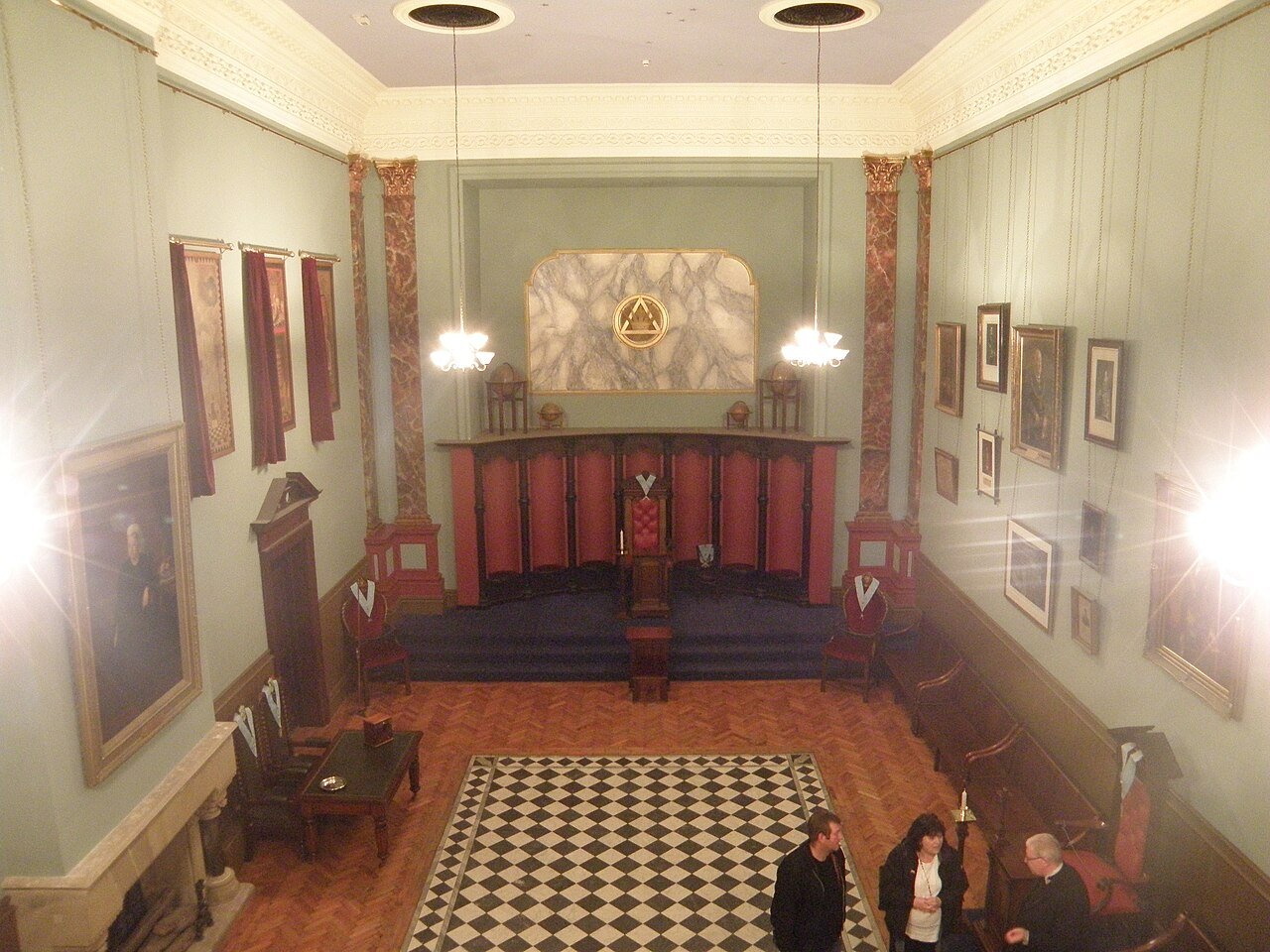
So where does the story of a secret god come from?
From two books, mainly. Walton Hannah’s Darkness Visible (1952) and Stephen Knight’s The Brotherhood (1984) took a word, gave it their own interpretation, and presented it as the secret name of a “Masonic God”. Critics of Freemasonry have repeated their reading ever since.
We will not discuss the content of Masonic ceremonies on this site, and we do not need to. The claim does not depend on what a word means. It depends on Freemasons having a god to worship, and they do not. A word is not a god, and a meeting that includes prayers to the Great Architect of the Universe, whom each member understands through his own faith, is not a temple of some other deity.
What did the Church of England say?
The claim is often backed up by a 1987 Church of England report, Freemasonry and Christianity: Are They Compatible?, which objected to this word in particular, and was approved by the Church’s General Synod by 394 votes to 52. The report is real, and the Church was entitled to its view on what language is proper when speaking of God.
But it is worth knowing what the Church did not do. Unlike the Methodist Church in England, which had recommended that its members avoid Masonic lodges, it did not ask its members to leave. During the debate Bishop Stanley Booth-Clibborn said there should be “no undue pressure on Christians who are Freemasons, and no witch hunt”, and the Archbishop of York, John Habgood, described Freemasonry as a “fairly harmless eccentricity”. That is hardly how one describes a secret cult of a pagan god. Churches’ differing views on Freemasonry are looked at in more detail in Claim #32.
Conclusion: Freemasons do not worship this or any other god as Freemasons, because there is no worship in Freemasonry. It has no god of its own, no name for one, no services and no theology; each member worships, or not, according to his own faith. The story of a secret god comes from two authors’ interpretation of a single word. Even the Church of England, which objected to the word, did not ask its members to leave their lodges. The claim is false. The accusation that Masons worship Satan is answered in Claim #05.
Sources:
What is Freemasonry? (this site)
United Grand Lodge of England, Board of General Purposes, “Freemasonry and Religion” (12 June 1985), reproduced by the Grand Lodge of the State of Louisiana: https://la-mason.com/shorttalk/freemasonry-and-religion-are-compatible/
United Grand Lodge of England, “What is Freemasonry?” (leaflet): https://skirret.com/papers/freemasonry_ugle.html
Grand Lodge of Minnesota, Masonic Manual and Monitorial Instructions (1998), “Minnesota’s Official Position” (the National Masonic Information Center statement on Freemasonry and religion), pp. 15–17
Walton Hannah, Darkness Visible (London: Augustine Press, 1952); Stephen Knight, The Brotherhood (1984)
Ken Samples, “Anglican Synod Concludes Freemasonry Is Heretical”, Christian Research Journal vol. 10 no. 1 (Summer 1987)