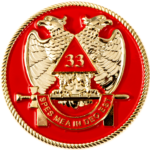
The Scottish Rite, properly the Ancient and Accepted Scottish Rite of Freemasonry, is the most widely practised Masonic rite in the world. In the United States and most English-speaking countries it is a body that a Master Mason may join after completing the three degrees of the Craft lodge, and it offers him a long series of further degrees, numbered from the 4th to the 32nd, with the 33rd conferred as an honour for outstanding service. In much of Europe and Latin America it goes further, working all thirty-three degrees from the very first.
Its degrees are best understood as a course in moral and philosophical education presented as drama. Drawing on the legend of King Solomon’s Temple, on the Bible, on the history of chivalry and on the religions and philosophies of many cultures, each degree poses a question about duty, honesty, justice, tolerance or faith, and leaves the member to find his own answer. The Rite’s American form owes most to Albert Pike, who rewrote its rituals in the nineteenth century and whose Morals and Dogma (1871) remains its best-known book.
Despite the name, the Rite did not come from Scotland. It grew out of the “Scottish” (Écossais) high degrees of eighteenth-century France, was carried to the Caribbean and North America by Estienne Morin and his deputies, and took its 33-degree form when the first Supreme Council opened at Charleston, South Carolina, on 31 May 1801.
This section covers the Rite in depth: its origins and organisation, the book A Bridge to Light on which the degree pages are based, and every degree from the 4° Secret Master to the honours of the 33rd degree, each illustrated with its apron, collar and jewel. Select the section below to enter.