The claim
CLAIM #41:
When you join the Freemasons, you have to ride a goat at your initiation?
FALSE
ANSWER:
No goat, live or mechanical, has any part in a Masonic ceremony. The joke, on the other hand, is very real, and Freemasons have been telling it on themselves for more than 150 years.
“Did they make you ride the goat?” Almost every new Freemason hears it from a grinning friend or relative. For most people it is a harmless joke. Online, though, it is sometimes served up with a darker twist: the goat is the Devil’s animal, so if Masons ride one, the lodge must be a place of devil worship. Let us take the goat by the horns.
Webmaster’s note: Let us follow that logic for a moment. If the goat really is the Devil’s animal, then every Christian who has ever enjoyed a goat curry, a slice of goat’s cheese or a glass of goat’s milk has been quietly inviting the Devil to lunch. Somebody had better warn the Book of Proverbs, which promises the faithful “goats’ milk enough for thy food, for the food of thy household” (Proverbs 27:27), and the instructions for the very first Passover, where the lamb could be taken “from the sheep, or from the goats” (Exodus 12:5). Either the Bible has been running a satanic dairy all along, or a goat is just a goat. We know where our money is.
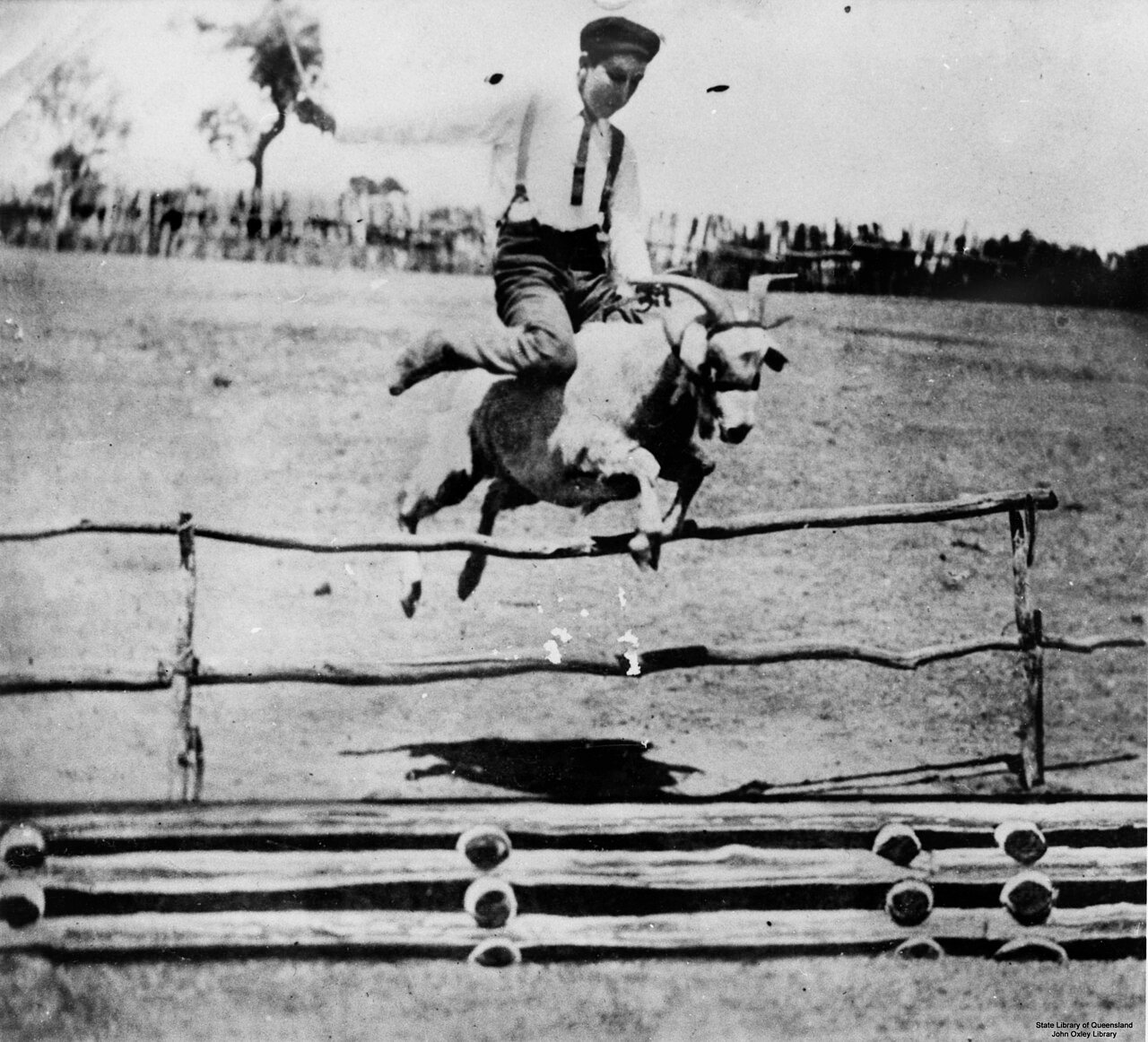
Where did the goat come from?
From the Middle Ages, not from the lodge. The nineteenth-century Masonic scholar Albert Mackey traced it back step by step. The ancient Greeks pictured their god Pan with horns, hooves and a goat’s shaggy hide; early Christians turned Pan’s features into the Devil’s; and medieval witch stories told of the Devil appearing at night-time gatherings riding on a goat. Because Freemasons met in private, gossip lumped them in with the witches. In Mackey’s words:
“The vulgar idea that “riding the goat” constitutes a part of the ceremonies of initiation in a Masonic Lodge has its real origin in the superstition of antiquity.”
Albert G. Mackey, Encyclopedia of Freemasonry (1916 edition), vol. 1, p. 315
He added that the goat “was transferred to the Freemasons; and the saying remains to this day, although the belief has very long since died out.” The record backs him up. The Grand Lodge of British Columbia and Yukon checked the early exposés of Masonic ritual, from 1723, 1730 and 1825, and the two great anti-Masonic books of 1797: not one of them mentions a goat. The earliest surviving use of “riding the goat” as initiation is in an 1845 attack on a different fraternity altogether, the Odd Fellows. It was attached to Freemasons only in the 1840s.
So were there ever real lodge goats?
Yes, and this is the fun part. In the late nineteenth century America went fraternity-mad, and some of the newer societies took the joke literally. The Modern Woodmen of America, an insurance fraternity founded in Iowa in 1883, used a mechanical goat. Ed DeMoulin, a blacksmith and inventor in Greenville, Illinois, began making lodge equipment for the Woodmen, his brother built the first mechanical goats, and the family firm, DeMoulin Bros., went on to sell goats and other prank devices to the Elks, the Moose, the Odd Fellows and others. They made fifteen versions and took out 32 patents for initiation gadgets. One catalogue boasted that “A ba-a-a attachment also makes this goat more goaty.” The Elks are also reported to have put candidates on a live goat as a prank before 1952.
Note who those customers were. The account of the DeMoulin story published by America’s National Endowment for the Humanities names no Masonic lodge among them, and the curator of the DeMoulin Museum, John Goldsmith, is clear about what the goats were for: “The fraternal orders didn’t condone any of the initiation devices,” he says. “They were not part of the actual initiation rituals. They were included to add some fun to the evening and improve attendance.” In fraternal slang, he explains, “there’s an expression that someone is going to ride the goat, meaning they were going to be initiated”. The goat was a figure of speech that a few clubs turned into a fairground ride.
Then why do Freemasons keep mentioning it?
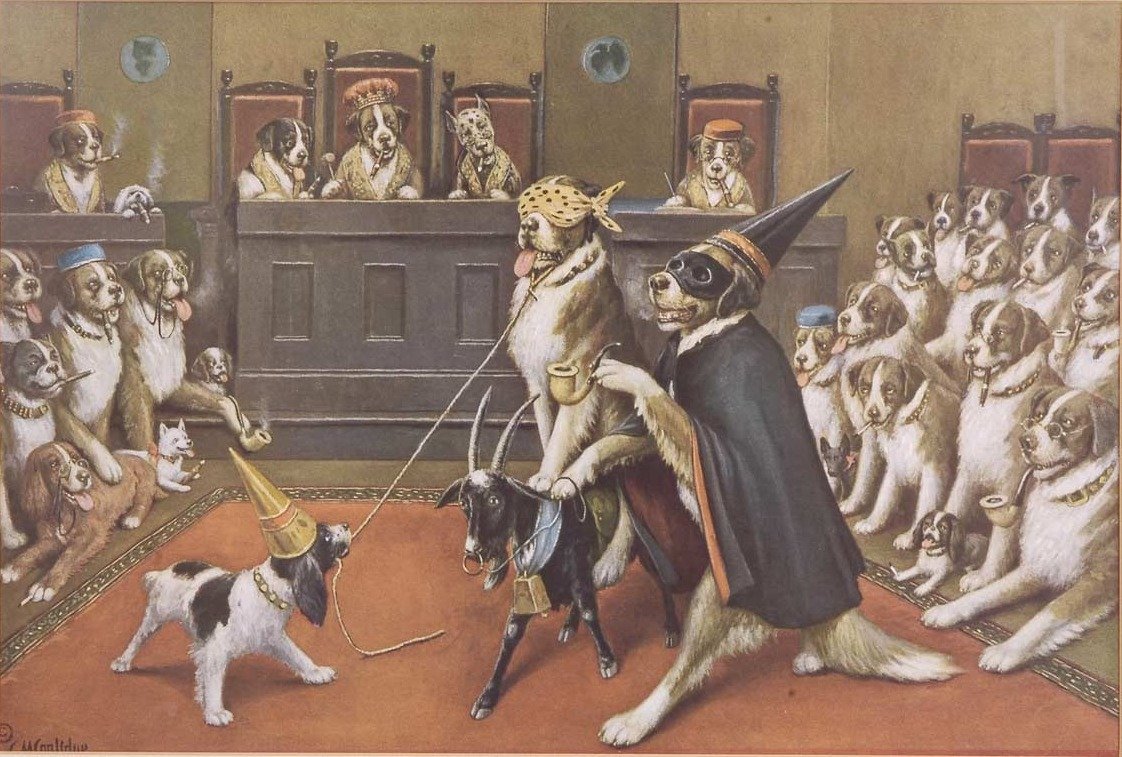
Because it is funny, and because they started it. By the end of the nineteenth century the goat was everywhere: there was an 1898 film called Riding the Goat, a “Riding The Goat” picture by Cassius Coolidge, the artist of the famous dogs playing poker, and a 1922 Mutt and Jeff cartoon of the same name. Masons joined in. In 1863 a newspaper in British Columbia reported on a Masonic dinner with a wink: “Not having yet taken a ride upon the mystical goat, we cannot say more than that the affair passed off well.”
The Grand Lodge of British Columbia and Yukon sums it up neatly: “That there was ever a popular belief in masonic goat-riding has not been demonstrated”, and “In its humorous form it is clear that the story has been kept alive by freemasons and not by anti-masons.” In other words, the goat is a family joke that escaped. Anyone who uses it to argue that lodges worship the Devil is taking a Victorian cartoon very seriously indeed. The goat-headed figure of Baphomet, which often gets mixed up with this story, is dealt with in Claim #17.
Conclusion: Freemasons do not ride goats. The idea began as medieval superstition about witches and the Devil, was first attached to fraternities in the 1840s (and to the Odd Fellows before the Masons), and became a favourite American joke. Some other fraternities really did buy mechanical goats as party pranks, but even their makers say these were never part of any real initiation. The only thing a new Freemason is likely to get from a goat is a well-worn joke at the dinner afterwards.
Sources:
Albert G. Mackey, Encyclopedia of Freemasonry (1916 edition), vol. 1, p. 315, “Goat, Riding the”
https://www.freemasonry.bcy.ca/anti-masonry/goat.html
https://www.neh.gov/article/marching-bands-secret-societies-and-mechanical-goats
https://www.biblegateway.com/passage/?search=Proverbs%2027%3A27&version=KJV
https://www.biblegateway.com/passage/?search=Exodus%2012%3A5&version=KJV
William D. Moore, “Riding the Goat: Secrecy, Masculinity, and Fraternal High Jinks in the United States, 1845–1930”, Winterthur Portfolio 41:2/3 (2007): https://web.archive.org/web/20260211210905/https://phoenixmasonry.org/Moore_Riding_the_Goat.pdf