


The Royal Arch of Solomon, also known as the Knight of the Ninth Arch, is the thirteenth degree of the Ancient and Accepted Scottish Rite. It tells the story of a treasure hidden deep underground by the patriarch Enoch and found again centuries later by Solomon’s builders. With the 14th degree that follows, it brings to a close the long search for what was lost in the Master Mason degree. Its moral lesson is quieter than its legend: character is formed slowly, one day and one choice at a time.
The degree at a glance
- Body: Lodge of Perfection (4th to 14th degrees), Southern Jurisdiction, USA
- Degree: 13th, Royal Arch of Solomon (also Knight of the Ninth Arch, Royal Arch of Enoch, or the Scottish Royal Arch)
- Other jurisdictions: the Northern Masonic Jurisdiction’s 13th degree is Master of the Ninth Arch
- Setting: King Solomon’s audience chamber (black hangings with silver tears, red and white columns, nine lights around a central altar), together with a second, completely dark room representing an underground vault strewn with rubble
- Pike’s lecture: Morals and Dogma, chapter XIII, “Royal Arch of Solomon”
This degree should not be confused with the Royal Arch degree of the York or American Rite. Albert Mackey calls the York or American version the Royal Arch of Zerubbabel, because its story is set at the building of the Second Temple, whereas this Scottish Rite degree is set at Solomon’s Temple. Rex Hutchens notes that degrees on this theme existed under several names before Albert Pike chose, combined and reworked the material in the nineteenth century. Whatever the name, he says, the core is always a legend about recovering something that had been lost.
The lesson
The legend begins long before Solomon, with Enoch. In Genesis (5:24) he is the man who “walked with God” and was taken from the earth without dying. Masonic tradition adds that, because of his virtue, God revealed His true Name to Enoch in a vision. To preserve it, Enoch dug nine chambers one above another, each roofed with an arch, the lowest cut into solid rock. In the deepest chamber he placed a triangular plate of gold engraved with the Name, set into a cube of agate on a pedestal of alabaster. Above it all he built a plain temple of unhewn stones. Hutchens links the rough stones to the command in Exodus 20:25 that God’s altars must not be shaped with tools.
Centuries later, the ground is cleared for a building connected with Solomon’s Temple, and the workmen come upon the ancient ruins and a hidden entrance. Three Masters lower one another into the darkness, each reaching further than the last. The third carries a torch and reaches the ninth arch, where he finds Enoch’s treasure. The cube is taken to Solomon, who recognises what is engraved on it. According to the legend, he created this degree to reward the zeal of the three discoverers.
Hutchens reads the story as a parable of searching. The torch that lights the final descent stands for knowledge and wisdom: only by their light, and by looking ever deeper within ourselves, is true knowledge of God found. The glowing alabaster pedestal stands for reason, God’s gift by which people can read the “great book of nature”. The three discoverers represent the true Mason, who looks for knowledge for honest reasons. Enoch’s name, which Hutchens connects with ideas of initiation and teaching, makes him the Masonic symbol of learning.
There is a civic thread here too. In Hutchens’s list of the political lessons of the Lodge of Perfection, the 13th degree stands for a constitution, or fundamental law, which is the foundation buried beneath the visible structure of a free state.
Duties of the degree
A Bridge to Light gives two duties for the Royal Arch of Solomon:
- to seek knowledge;
- to be guided in all things by duty and honour.
Its lessons are that moral character is a habit and is never formed in a moment, and that a great law of retribution operates both in our memory, as remorse, and at the final judgment. Pike’s lecture takes a broad view of what this means in practice. He speaks of a “religion” of daily life, by which he means not a church but the faithful use of everything God has given us. There is, he says, a religion of toil, of business and of friendship. Honest work done for the people we love, and the “sacred faith of man in man” that allows trade and society to function, are themselves ways of serving God.
Symbols and regalia
The apron is crimson velvet. On it is a triangle giving off rays, with an archaic form of the Hebrew letter Yod in the middle. The crimson stands for the zeal and devotion of a Royal Arch Mason. The triangle stands for God, understood as infinite wisdom, power and harmony, and the letter stands for the divine Name made known to Moses.
The cordon (shown as the collar) is a broad purple watered ribbon worn from the right shoulder to the left hip, with a triangle of gold bars hanging from it.
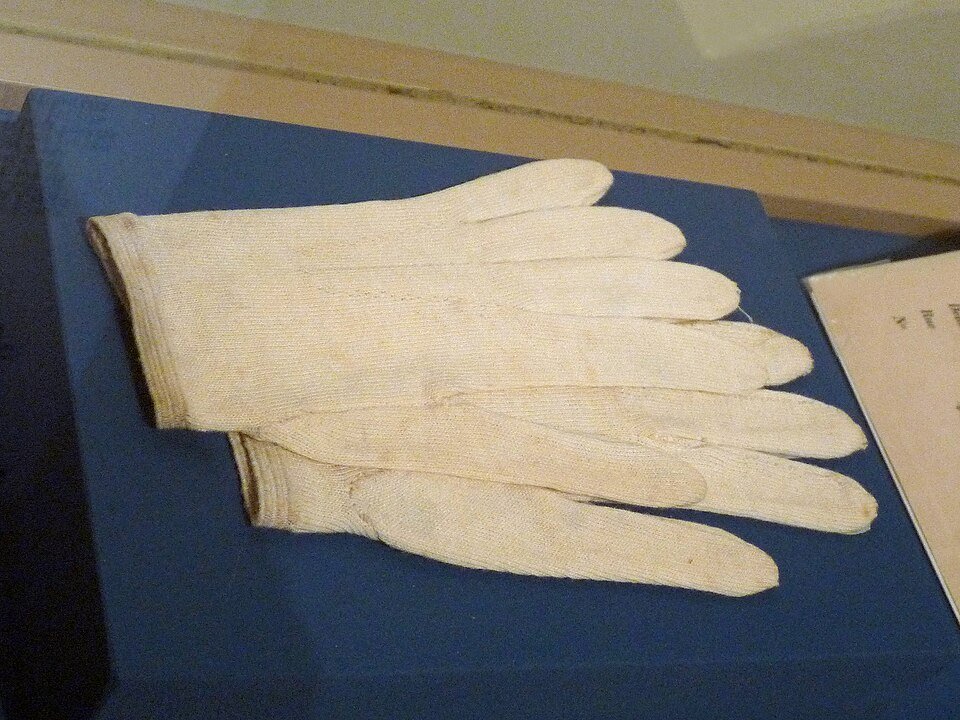
The jewel is a round gold medal worn on the breast from a narrow white ribbon. One side shows an opening in the ground through which two men are lowering a third on a rope, surrounded by the letters R, S, R, S, T, P, S, R, I, A, J, et S, and the date ANNO ENOCHI 2995. A Bridge to Light gives the Latin they abbreviate, Regnante Solomone, Rege Sapientissimo, Thesaurum Pretiosissimum Sub Ruinis Invenerunt Adoniram, Joabert, et Satolkin, and translates it: “In the reign of Solomon, wisest of kings, Adoniram, Joabert and Satolkin found under the ruins the most precious treasure.” The other side repeats the rayed triangle and letter of the apron. Hutchens says it should remind the wearer to revere the Grand Architect of the Universe and to play his own part in the world faithfully, on the path of honour and duty. The gloves pictured are plain white Masonic gloves; A Bridge to Light describes no special gloves for this degree.

Other important symbols listed in A Bridge to Light include Enoch himself, the descent into the vault, the arch, the cube of agate and the triangle of gold.
Reflections
The question A Bridge to Light poses is a searching one: are idle hours and idle words also subject to the great law of retribution? Pike’s answer is that nothing is wasted without cost:
“The great law of Retribution is, that all coming experience is to be affected by every present feeling; every future moment of being must answer for every present moment.”
Albert Pike, Morals and Dogma, 13th degree
In the following lecture he gives the positive side of the same idea, urging the Mason “to make honor and duty the steady beacon-lights” of his life. Enoch’s vault was dug one arch at a time, and the degree suggests that character is built the same way, out of ordinary hours that each leave their mark.
Please view the video on the left, for a more detailed explanation of the 13th° Degree.
Sources:
Rex R. Hutchens, A Bridge to Light: The Revised Standard Pike Ritual, 4th ed., edited by Arturo de Hoyos (Washington, D.C.: The Supreme Council, 33°, S.J., 2010), chapter “The 13th Degree – Royal Arch of Solomon”. Purchase ‘A Bridge To Light‘ by Rex R. Hutchens
Albert Pike, Morals and Dogma of the Ancient and Accepted Scottish Rite of Freemasonry (1871), chapter XIII “Royal Arch of Solomon”; also chapter XIV. Purchase ‘Morals & Dogma‘ by Albert Pike.
Albert G. Mackey, Encyclopedia of Freemasonry, entries “Royal Arch of Solomon” and “Royal Arch of Zerubbabel”
The Bible: Genesis 5:21–24; Exodus 20:25
Scottish Rite, Northern Masonic Jurisdiction, “Degrees”: scottishritenmj.org
Wikipedia, “Scottish Rite” (table of degree names by jurisdiction)