


The Perfect Elu, formally titled Grand Elect, Perfect and Sublime Mason, is the fourteenth degree of the Ancient and Accepted Scottish Rite and the last degree of the Lodge of Perfection. It is often called the Degree of Perfection, because it completes the story that began in the Master Mason degree. In the allegory, what was lost is finally restored. Albert Pike, however, is careful to say that the “perfection” in its title is something to aim for, not something anyone has yet achieved.
The degree at a glance
- Body: Lodge of Perfection (4th to 14th degrees), Southern Jurisdiction, USA; this degree gives the Lodge its name
- Degree: 14th, Perfect Elu (Grand Elect, Perfect and Sublime Mason)
- Other jurisdictions: the Northern Masonic Jurisdiction’s 14th degree is Grand Elect Mason, and in England and Wales the title is Grand Elect, Perfect and Sublime Master
- Setting: the innermost chamber of a secret vault beneath Solomon’s Temple, reached by a dim passage under nine arches and itself brilliantly lit, decorated in gold and white with crimson hangings painted with white columns
- Pike’s lecture: Morals and Dogma, chapter XIV, “Grand Elect, Perfect, and Sublime Mason”
The 4th to 14th degrees are traditionally called the “Ineffable Degrees”. Albert Mackey explains that the name comes from their focus on the Ineffable Name of God, the Name that may not be spoken. Mackey also records that the old French title of this degree referred to the “Sacred Vault of James VI”, and he saw this as evidence of the influence of the exiled Stuart kings and their supporters on eighteenth-century high-degree Masonry. Rex Hutchens adds that the degree was later rewritten to remove those political aims and give it a more religious and philosophical character.
The lesson
The legend follows directly from the 13th degree. The cube of agate bearing the Name of God, recovered from Enoch’s vault, is placed by King Solomon in a private vault of his own. This vault lay between his most private apartment and the Holy of Holies, and was used only by Solomon, Hiram King of Tyre and Hiram Abif for their private meetings.
Hutchens finds the key to the degree in the contrast between the two vaults. Enoch’s was dug straight down. Its vertical line points to the spiritual world, and Enoch, after completing his task, was taken to heaven without dying. Solomon’s vault runs horizontally, the direction of earthly things, and Solomon’s wisdom was the practical wisdom of a ruler. He governed others well but, as the Bible records, governed himself less well in later life. Put the vertical and the horizontal together and they form a cross. Hutchens says that this union of the spiritual and the earthly, “living this life to the fullest while preparing for the next”, is the perfection Masonry teaches, and that the lesson is completed in the 18th degree. Both vaults also lie underground, which turns attention inward. As every Craft Mason is taught, it is the internal and not the external qualifications that matter.
Hutchens describes the ceremony as including two very old symbolic acts. The first is purification by water, which he traces to ancient practices among the Hindus, Egyptians and Greeks long before Christian baptism. The second is a shared meal of bread and wine, in the spirit of ancient offerings, which marks the new member’s bond with his brethren. Everything else that passes in the vault is reserved for those who receive the degree, and it is left out here.
The lessons A Bridge to Light draws from the degree are that Perfect Elus are at once bound and free: bound by their commitment, and free from prejudice, intolerance and envy. It also teaches that Masons meet on the level because in their lives authority and liberty are held in balance.
Duties of the degree
The duties of a Perfect Elu, as given in A Bridge to Light, are:
- to assist, encourage and defend one’s brethren;
- to protect the oppressed and relieve want and distress;
- to enlighten the people;
- to serve the common good and be fruitful in good works.
Because this degree completes the Lodge of Perfection, it also looks back on everything that came before. Hutchens sums up the duty taught in each degree in a single line:
- 4th: silence, obedience and fidelity
- 5th: honesty, sincerity and good faith
- 6th: zeal, faithfulness, unselfishness, benevolence, and acting as a peacemaker
- 7th: judging justly and impartially, doing justice to all
- 8th: benevolence, charity and sympathy for those in one’s employ
- 9th: destroying ignorance
- 10th: contending against tyranny and fanaticism
- 11th: being earnest, true and reliable, and a champion of the people’s rights
- 12th: seeking truth and right
- 13th: being guided by honour and duty
- 14th: devotion to virtue and to the cause of humanity
Symbols and regalia
The apron is white lambskin, lined with crimson and edged with blue, with a fine crimson wreath of flowers embroidered inside the border. The jewel of the degree is shown in the centre. On the flap is a flat square stone fitted with a ring, which is the entrance to the secret vault of the 13th degree. Each colour has a meaning: white for justice, blue (the colour of the unchanging sky) for right, and crimson (the colour of the fire that tests and purifies) for truth.
The collar is crimson velvet, worn around the neck and coming to a point on the breast. On the left side a sprig of acacia is embroidered in green, for immortality. On the right is a silver five-pointed star, the emblem of Masonic light, carrying a Phoenician word that means “perfection”.
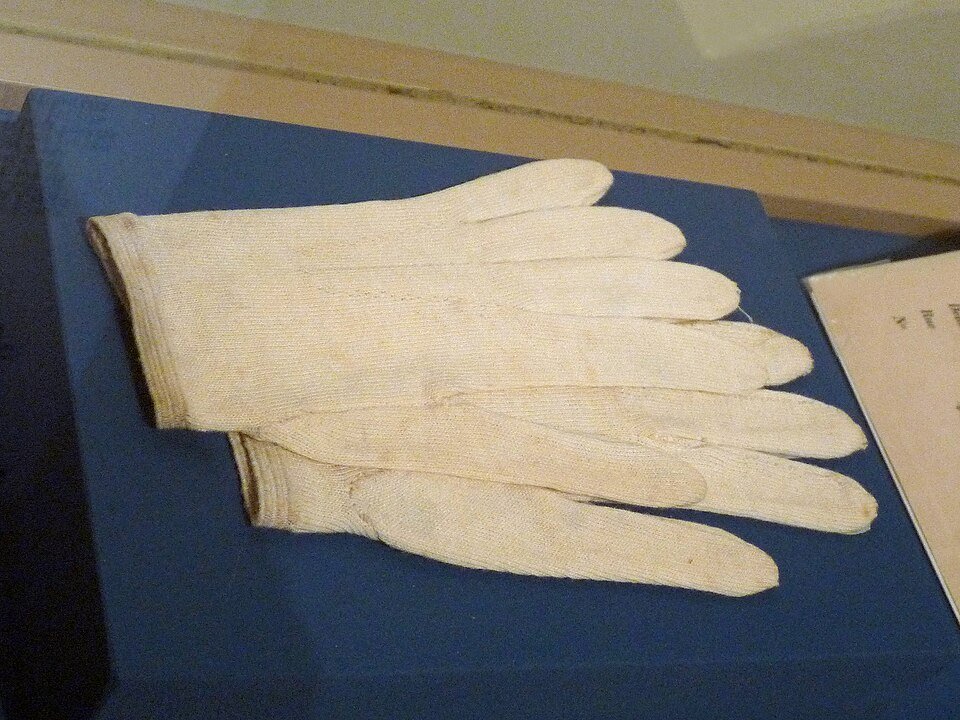
The jewel is a pair of gold compasses opened on a quarter-circle and topped by a pointed crown. On the arc are the numerals 3, 5, 7 and 9. Inside the compasses is a medal showing the sun on one side, and on the other a five-pointed star containing a triangle inscribed with the Name of God. Hutchens explains that the compasses recall how science, joined to honour and virtue, made the architect of the Temple a companion of kings. The sun and the star stand for the light every Mason travels in search of: a true knowledge of God and of the laws that govern the universe. According to A Bridge to Light, white gloves are worn in this degree as a symbol of purity.

A newly made Perfect Elu also becomes entitled to the 14th degree ring, perhaps the most recognisable piece of Scottish Rite jewellery. It is inscribed with the Latin motto Virtus junxit mors non separabit, “Virtue has united, and death shall not separate”, as Hutchens translates it. Pike linked the custom to rings given in ancient initiations as tokens of divine protection, and Hutchens adds that, like a wedding ring, it stands for a lasting covenant. Other symbols of the degree include the cube, the Seal of Solomon, the columns, the triangular lighted pedestal and a great seven-branched candlestick.
Reflections
The question A Bridge to Light sets here is the natural one: if perfection cannot be reached, what is the Mason striving for? Pike answered it directly:
“Perfect truth is not attainable anywhere. We style this Degree that of Perfection; and yet what it teaches is imperfect and defective. Yet we are not to relax in the pursuit of truth … and thus Masonry is a continual struggle toward the light.”
Albert Pike, Morals and Dogma, 14th degree
The same lecture closes with a welcome that sums up the generous spirit of the whole Lodge of Perfection. If a man believes that the universe is not without a God, and that he has an immortal soul, then, in Pike’s words, “we welcome you among us, to wear, as we wear, with humility, and conscious of your demerits and shortcomings, the title of Grand Elect, Perfect, and Sublime Mason.”
Please view the video on the left, for a more detailed explanation of the 14th° Degree.
Sources:
Rex R. Hutchens, A Bridge to Light: The Revised Standard Pike Ritual, 4th ed., edited by Arturo de Hoyos (Washington, D.C.: The Supreme Council, 33°, S.J., 2010), chapter “The 14th Degree – Perfect Elu”. Purchase ‘A Bridge To Light‘ by Rex R. Hutchens
Albert Pike, Morals and Dogma of the Ancient and Accepted Scottish Rite of Freemasonry (1871), chapter XIV “Grand Elect, Perfect, and Sublime Mason”. Purchase ‘Morals & Dogma‘ by Albert Pike.
Albert G. Mackey, Encyclopedia of Freemasonry, entries “Grand Elect, Perfect and Sublime Mason”, “Perfection, Lodge of” and “Ineffable Degrees”
Scottish Rite, Northern Masonic Jurisdiction, “Degrees”: scottishritenmj.org
Wikipedia, “Scottish Rite” (table of degree names by jurisdiction)