


The Elu of the Twelve, also called Prince Ameth or Sublime Elect of the Twelve, is the eleventh degree of the Ancient and Accepted Scottish Rite and the last of the three Elu degrees in the Lodge of Perfection. With the story of Hiram’s murderers now finished, the degree turns from justice to government and asks what is owed to the ordinary people a Mason may be called to serve. Its answer is short: be true, and work for them.
The degree at a glance
- Body: Lodge of Perfection (4th to 14th degrees), Southern Jurisdiction, USA
- Degree: 11th, Elu of the Twelve or Prince Ameth (Sublime Elect of the Twelve; Mackey also gives Sublime Knight Elected)
- Other jurisdictions: the Northern Masonic Jurisdiction’s 11th degree is Sublime Master Elected
- Setting: King Solomon’s audience chamber, hung in black with red and silver tears and lit by twelve candles, three in a triangle in each quarter of the room
- Pike’s lecture: Morals and Dogma, chapter XI, “Sublime Elect of the Twelve; or Prince Ameth”
The title comes from a Hebrew word (more correctly emeth, as Mackey notes) that carries the ideas of truth, fidelity, firmness and keeping one’s promises. A Prince Ameth is a “Prince of Truth”. Hutchens suggests that the twelve candles, placed in all four quarters of the room, can be read in two ways: as the presence of God everywhere, or as a reminder that the duties of the degree belong in every part of a Mason’s life.
The lesson
In outline: the men captured in the 10th degree are brought to trial, confess and are judged under the Law of Moses. King Solomon then declares that from now on the Master Hiram will stand for unshakeable fidelity, and his murderers for ignorance, ambition and fanaticism. With that, the story of the crime is closed.
The second half of the drama deals with an everyday injustice. Complaints arrive from across the kingdom: the officials collecting the king’s tribute are taking far more from the people than ever reaches the treasury. On the advice of Hiram, King of Tyre, Solomon decides to appoint trustworthy officers of his own and pay them fairly. Mackey’s version says that twelve of the fifteen Elus are chosen by lot, so that no one could take offence at the choice, and that they are made governors over the twelve tribes and given charge of the revenue. They are then raised to the rank of Prince Ameth and charged with protecting the people from unlawful demands.
Pike gives the number twelve a further meaning. Following the legislature of the 9th and 10th degrees, he points to another safeguard of liberty: trial by a jury of twelve, whose verdict must be unanimous before anyone can be convicted. In Hutchens’s summary of the political lessons of the Lodge of Perfection, the 7th degree stands for an independent judiciary, the 9th and 10th for the two houses of a legislature, and the 11th for trial by jury.
The lecture widens this into a philosophy of life. Pike calls life a school, a place of training and discipline rather than a prison or a playground, in which families, communities and nations are the classrooms and every circumstance is a lesson. In his view, Masonry’s special task in that school is to protect, educate and improve the condition of ordinary working people, which is why he insisted it must be active rather than ornamental.
Duties of the degree
A Bridge to Light sums up the duties of a Prince Ameth in two lines:
- be earnest, true and reliable, so that no one who depends on your word is let down;
- be the advocate and champion of the people, and guard them against unlawful impositions.
Hutchens points out that these duties spread outward, from the Mason himself to his family, his lodge, his neighbours, his country and finally the whole human family. The lecture also uses them to review earlier lessons, including fidelity from the 4th degree and the contemplation of death from the 5th.
Symbols and regalia
The apron is white, lined, edged and fringed with black, with a black flap. In its centre is an embroidered flaming heart, which stands for the zeal that should drive every Mason and for the many people throughout history who have suffered or given their lives for others or for their country.
The cordon (shown as the collar) is a broad black watered ribbon worn from the right shoulder to the left hip. It carries the same flaming heart and the Latin motto Vincere aut Mori, “to conquer or to die”. This is a pledge to die rather than betray the cause of the people, or to be defeated through one’s own failings.
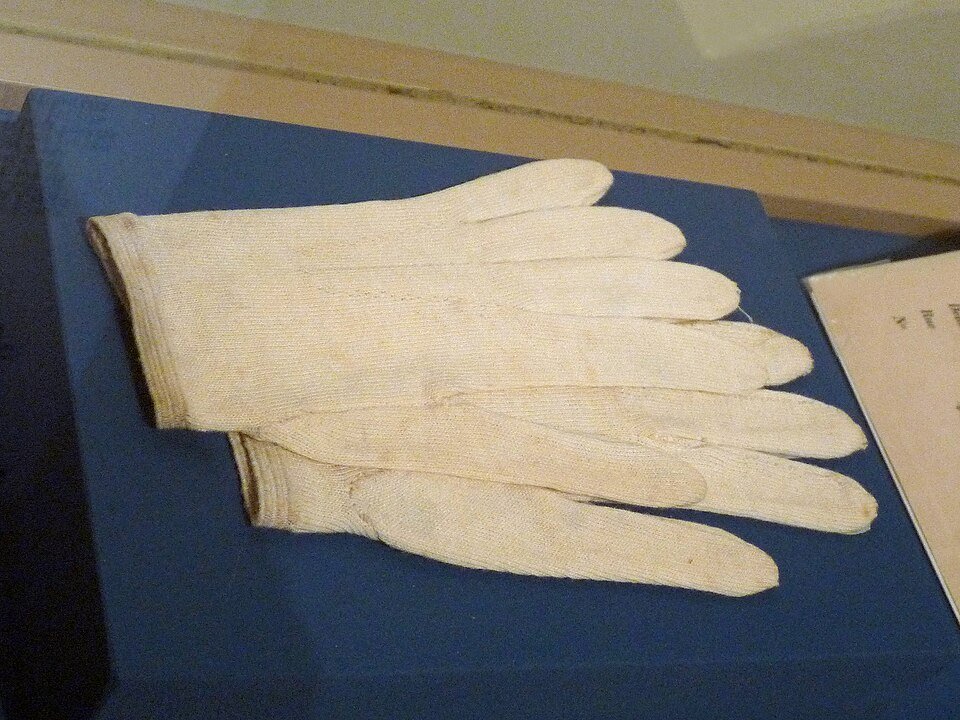
The jewel is a sword of gold hanging from the cordon. It stands for truth, recalling the Epistle to the Hebrews (4:12), where the word of God is described as sharper than any two-edged sword. The gloves pictured are plain white Masonic gloves, as on the earlier Elu pages; A Bridge to Light describes no special gloves for this degree.

A Bridge to Light also lists among the important symbols the twelve Elus themselves and the brethren’s swords held with their points touching in a circle. This image appears in the 10th degree too, and shows the repeated renewal of a shared commitment.
Reflections
The reflection question for this degree is: is Masonry’s work ever completed? Pike’s answer was a firm no, and it is the source of one of his best-known lines:
“It is because Masonry imposes upon us these duties that it is properly and significantly styled work.”
Albert Pike, Morals and Dogma, 11th degree
He goes on to say that anyone who thinks he has become a Mason simply by receiving the first few degrees, and can then wear its honours without effort or sacrifice, “is strangely deceived.” In his lecture for the 14th degree Pike repeats the point more gently: “Life is real, and is earnest, and it is full of duties to be performed.” The Prince of Truth is not meant to be a title for display. It is a reminder that every promise is a debt to be paid.
Please view the video on the left, for a more detailed explanation of the 11th° Degree.
Sources:
Rex R. Hutchens, A Bridge to Light: The Revised Standard Pike Ritual, 4th ed., edited by Arturo de Hoyos (Washington, D.C.: The Supreme Council, 33°, S.J., 2010), chapter “The 11th Degree – Elu of the Twelve or Prince Ameth”. Purchase ‘A Bridge To Light‘ by Rex R. Hutchens
Albert Pike, Morals and Dogma of the Ancient and Accepted Scottish Rite of Freemasonry (1871), chapter XI “Sublime Elect of the Twelve; or Prince Ameth”; also chapter XIV. Purchase ‘Morals & Dogma‘ by Albert Pike.
Albert G. Mackey, Encyclopedia of Freemasonry, entries “Sublime Knight Elected”, “Ameth” and “Elus”
Scottish Rite, Northern Masonic Jurisdiction, “Degrees”: scottishritenmj.org
Wikipedia, “Scottish Rite” (table of degree names by jurisdiction)