


The Elu of the Fifteen, also called the Illustrious Elect of the Fifteen, is the tenth degree of the Ancient and Accepted Scottish Rite and the second of the Elu degrees in the Lodge of Perfection. It finishes the story begun in the 9th degree and closes the Scottish Rite’s version of the legend of Hiram Abif. Its real theme is toleration: the right of every person to hold an honest belief, and the duty to resist those who would force their own belief on others.
The degree at a glance
- Body: Lodge of Perfection (4th to 14th degrees), Southern Jurisdiction, USA
- Degree: 10th, Elu of the Fifteen (Illustrious Elect of the Fifteen)
- Other jurisdictions: the Northern Masonic Jurisdiction’s 10th degree is Master Elect, and many other Supreme Councils use the form Elect of Fifteen
- Setting: King Solomon’s audience chamber, hung in black with red and silver tears and lit by three groups of five yellow candles
- Companion degree: usually conferred together with the 9th degree
- Pike’s lecture: Morals and Dogma, chapter X, “Illustrious Elect of the Fifteen”
Masons whose Craft lodge concludes the Hiramic story in the third degree may find this part of the Scottish Rite unfamiliar. As Rex Hutchens points out in A Bridge to Light, in the Scottish Rite the fugitives are not caught in the Master’s degree at all; that happens in the 9th and 10th. Albert Mackey describes the 10th as “the continuation and conclusion” of that story, and he records the same degree in the older Chapter of Emperors of the East and West and in the Rite of Mizraim.
The lesson
In outline: word reaches Jerusalem that the two remaining fugitives are hiding in the land of Gath. King Solomon adds six more Masters to the original nine and sends the fifteen with a letter to the ruler of that country. They find the two men among the workmen at a quarry, take them alive and bring them back to Jerusalem, where they are tried and punished under the law. The fifteen are rewarded by being formed into a new order, the Elus of the Fifteen. Like the 9th, the drama gives the guilty men a voice: one is crushed by remorse, while the other is tormented by a recurring nightmare.
Again, nothing here is meant literally. Hutchens explains the three fugitives as symbols of the three special enemies of freedom. The first, dealt with in the 9th degree, is ignorance. The two captured here are ambition, from which tyranny and despotism grow, and fanaticism, which produces intolerance and persecution. Hutchens also uses this degree, which formally closes the Hiramic allegory, to discuss what the attack on the Master symbolises: a loss of freedom of speech, of conscience and of thought.
There is a civic lesson too. Pike treated the two Elu bodies as a picture of an independent legislature. The Nine, fewer and longer-serving, stand for the upper house, and the larger Fifteen stand for the lower house.
Pike’s lecture for the degree is one of the clearest statements of what he believed Masonry is and is not. Masonry, he says, “is not a religion”. It asserts no creed, has no priesthood and offers no revelation of its own. What it does teach is a universal morality that men of every faith can share. From that follows the degree’s central virtue: tolerance of other people’s sincere convictions, joined with what Pike calls liberality, the humility to accept that an honest person who disagrees with us may be the one who is right.
Duties of the degree
A Bridge to Light gives the duties of the Elu of the Fifteen as:
- to be tolerant and liberal toward the opinions and faith of others;
- to oppose fanaticism and persecution, using education and enlightenment rather than force.
These build on the 9th degree’s duties to instruct the people and to watch over one’s country. In the ceremony the new Elu lights candles of yellow wax, a colour Hutchens associates with the sun and so with light and knowledge, and nine knightly virtues are named as each candle is lit. The book is careful to add that these virtues are not the Elu’s main business. His principal work is to teach and enlighten, freeing people from superstitious fear and blind obedience.
Symbols and regalia
The apron is white, lined, edged and fringed with black, and its flap is black. On its body are three arched gates, each crowned with a red rosette. The rosettes stand for the three fugitives of the legend and, through them, for the vices Masonry most opposes. According to the legend, the gates are the east, west and south gates of Jerusalem, where the sentence on the three was made public.
The cordon is a broad black watered ribbon worn from the right shoulder to the left hip. On its front are three rosettes with the same meaning as those on the apron.
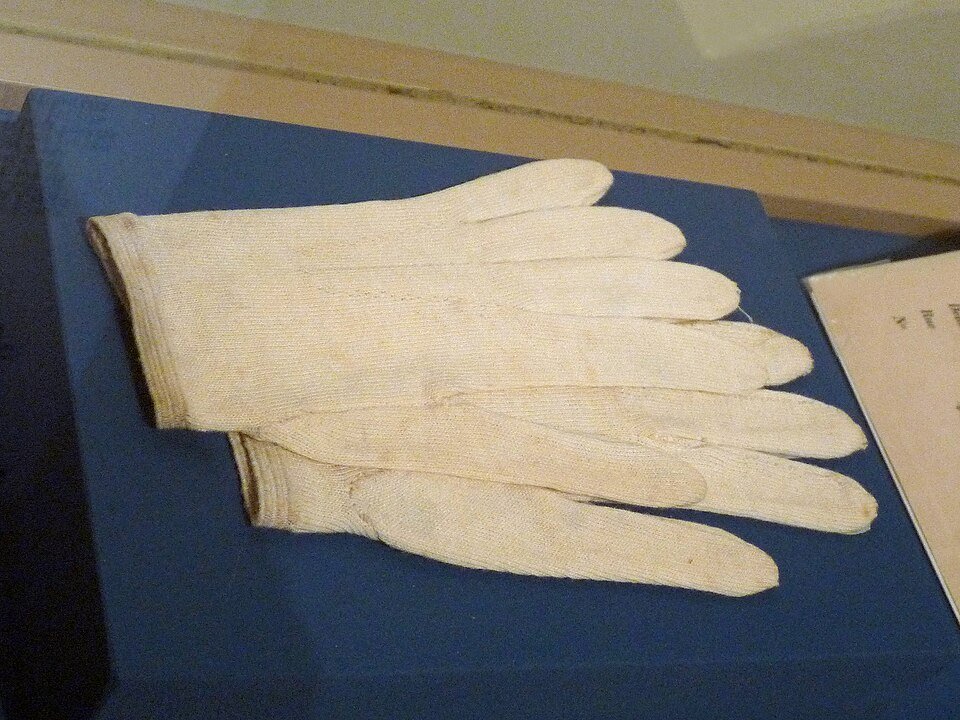
The jewel is the same as in the 9th degree: a dagger with a golden hilt and a silver blade, hanging from the end of the cordon. As before, it stands for the sword of truth and not for revenge. The gloves pictured are plain white Masonic gloves; A Bridge to Light describes no special gloves for this degree.

Two other symbols named in A Bridge to Light are the fifteen yellow candles and the circle of swords with their points touching, a picture of brethren united in the same commitment.
Reflections
The question A Bridge to Light sets for this degree is a hard one: are you tolerant even of intolerance? Pike’s answer starts from a simple principle:
“No man is responsible for the rightness of his faith; but only for the uprightness of it.”
Albert Pike, Morals and Dogma, 10th degree
Elsewhere in the same lecture he defines toleration as “holding that every other man has the same right to his opinion and faith that we have to ours”. He is equally firm that no one may take on “the prerogative of Deity” by condemning another person’s faith as deserving punishment. The 10th degree asks its members to keep both principles at once: to respect sincere belief, and to refuse to let anyone’s certainty turn into persecution.
Please view the video on the left, for a more detailed explanation of the 10th° Degree.
Sources:
Rex R. Hutchens, A Bridge to Light: The Revised Standard Pike Ritual, 4th ed., edited by Arturo de Hoyos (Washington, D.C.: The Supreme Council, 33°, S.J., 2010), chapters “The 9th Degree – Elu of the Nine & 10th Degree – Elu of the Fifteen” and “The 11th Degree” (legislature symbolism). Purchase ‘A Bridge To Light‘ by Rex R. Hutchens
Albert Pike, Morals and Dogma of the Ancient and Accepted Scottish Rite of Freemasonry (1871), chapter X “Illustrious Elect of the Fifteen”. Purchase ‘Morals & Dogma‘ by Albert Pike.
Albert G. Mackey, Encyclopedia of Freemasonry, entries “Elect of Fifteen” and “Elus”
Scottish Rite, Northern Masonic Jurisdiction, “Degrees”: scottishritenmj.org
Wikipedia, “Scottish Rite” (table of degree names by jurisdiction)