


The Elu of the Nine is the ninth degree of the Ancient and Accepted Scottish Rite and the first of three “Elu” degrees in the Lodge of Perfection. It picks up the story of Hiram Abif where the Master Mason degree leaves it and follows the search for those who killed him. Behind that dark setting, the degree’s real subject is the struggle against ignorance, which Albert Pike treated as the oldest enemy of human freedom.
The degree at a glance
- Body: Lodge of Perfection (4th to 14th degrees), Southern Jurisdiction, USA
- Degree: 9th, Elu of the Nine (also styled Elected Knight of the Nine, or Elect of Nine)
- Other jurisdictions: the Northern Masonic Jurisdiction confers its own 9th degree under the name Master of the Temple
- Setting: a Chapter hung in black strewn with silver tears, with red and white columns at intervals
- Companion degree: in the Southern Jurisdiction the 9th and 10th degrees are usually conferred together, because they tell one continuous story
- Pike’s lecture: Morals and Dogma, chapter IX, “Elect of the Nine”
“Elu” is simply French for “elected” or “chosen”. The Elu degrees take their name from the Masters who, in Masonic legend, were chosen to find the murderers of Hiram. Albert Mackey notes that in the York and American Rites this episode is folded into the Master Mason degree, the French Rite makes it a single separate degree, and the Scottish Rite spreads it across three: the 9th, 10th and 11th. That is why a Mason who has seen the matter concluded in his own Craft lodge may be surprised to find it reopened here.
The lesson
In outline, the legend runs like this. King Solomon chooses nine Masters to look for the men who murdered Hiram. Led by a poor herdsman who has seen strangers hiding in the hills, they find one of the fugitives asleep in a cave, lit only by a single lamp beside a running spring. He is overcome, and the nine return to Jerusalem to report that justice has been done. The fugitive’s own remorse is a strong theme of the drama: his guilty conscience has punished him more severely than any human court could.
Nobody is meant to take this as a tale of revenge. Mackey warned that anti-Masonic writers had misread the Elu degrees as teaching a spirit of vengeance, and he insisted that they “must be looked upon as conveying only a symbolic meaning.” Rex Hutchens is just as direct in A Bridge to Light: “If the decapitation of the assassin in the cavern were not symbolical, the incident would have no place in Masonry.”
The symbolism is political and moral. Hiram stands for human freedom and the fugitive in the cave stands for ignorance, which the degree calls the chief enemy of that freedom. The herdsman who shows the way stands for a free press, which, together with knowledge and liberty, helps to defeat ignorance. The cave stands for a mind imprisoned by superstition and deceit, and its feeble lamp for the poor substitute that tyranny over conscience offers in place of the full light of truth. Pike also saw the Nine as standing for one institution of free government, the upper house of an independent legislature: a small body of mature members elected for longer terms.
The second lesson is about conscience. The degree teaches that remorse is God’s own punishment for wrongdoing and that it is harder to bear than any sentence a court can hand down. Wrongdoing has consequences whether or not the world ever discovers it.
Duties of the degree
Pike summed up the duties of an Elu of the Nine in a single charge: “Protect the oppressed against the oppressor; and devote yourself to the honor and interests of your Country.” A Bridge to Light sets them out in practical terms:
- to enlighten one’s own soul and mind;
- to instruct and enlighten the people;
- to be watchful over the interests and the honour of one’s country.
Pike was careful to say that this patriotism is not a licence for unrest. He argued that Masonry supports lawful government and its officers, while also teaching that power is held in trust for the people and that a government which abuses it has broken its side of the bargain. In his view, education is what holds the balance between the two, because an informed people knows its rights and cannot be oppressed for long.
Symbols and regalia
The apron is white lambskin, lined and bordered in black. Its central image is a candle burning in darkness, which stands for the weak light of ignorance, error and intolerance in which the world is wrapped. On the flap is a star, for Masonry moving through that darkness and spreading knowledge and tolerance as it goes.
The cordon (shown here as the collar) is a broad band of black watered ribbon worn from the right shoulder to the left hip. Near its lower end are nine red rosettes, four on each side and one at the point. They recall the nine Elus of the legend and nine virtues the degree asks its members to practise: disinterestedness, courtesy, devotion, firmness, frankness, generosity, self-denial, heroism and patriotism. The black itself is a reminder to mourn how widespread ignorance, oppression and error still are.
The jewel is a dagger with a golden hilt and a silver blade. Hutchens reads the two metals as the light of the sun and moon combined, and compares this with the old Chinese character for “brilliant”, which is formed by joining the characters for sun and moon. The dagger is not a badge of bravado. It stands for the lawful weapons an Elu may use and, above all, for the two-edged sword of truth. Pike returns to it in the 25th degree, linking it to the dagger of the Mithraic mysteries, whose black blade and white hilt stood for the two principles of Light and Darkness. A related blade appears again, as a poniard, in the 30th degree.
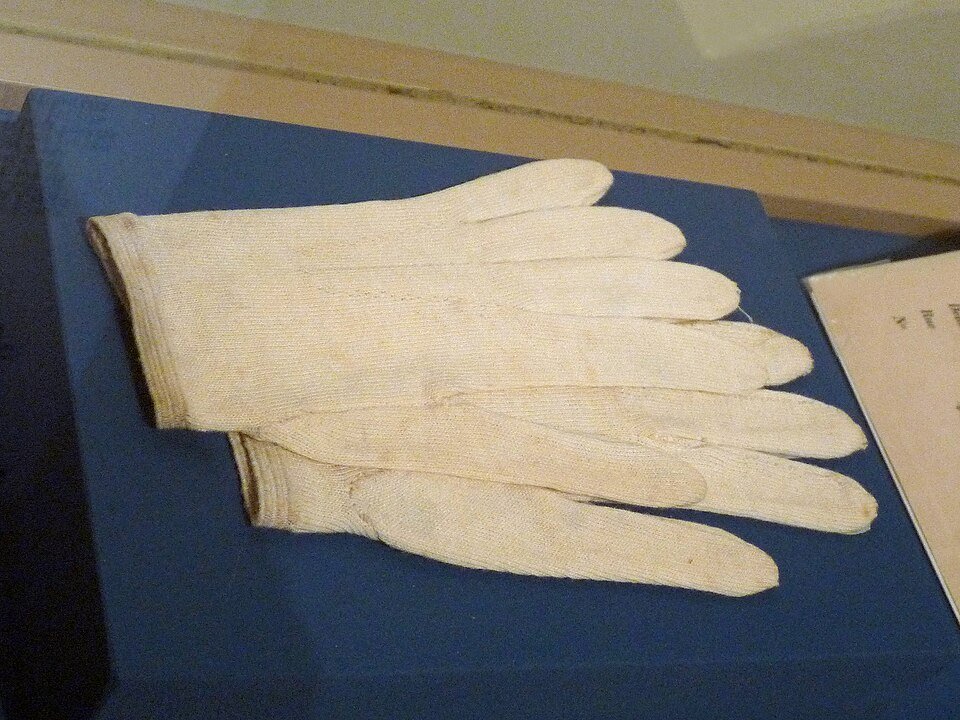
The gloves pictured are plain white Masonic gloves. A Bridge to Light describes no special gloves for this degree.

Reflections
A Bridge to Light closes each degree with a question for the reader. For the 9th degree it asks whether one’s conduct is shaped and controlled by principles, or simply guided by sentiment. Pike drew the same distinction in his lecture:
“Most men have sentiments, but not principles. The former are temporary sensations, the latter permanent and controlling impressions of goodness and virtue.”
Albert Pike, Morals and Dogma, 9th degree
Looking back on the Elu degrees in his lecture for the 14th degree, Pike described Masonry as a hero locked in combat with “the demons of ignorance, brutality, baseness, falsehood, slavishness of soul, intolerance, superstition, tyranny, meanness, the insolence of wealth, and bigotry.” The vocabulary is dramatic, but the duty it describes is an ordinary one: to keep learning, to help others learn, and not to look away when someone weaker is being pushed around.
Please view the video on the left, for a more detailed explanation of the 9th° Degree.
Sources:
Rex R. Hutchens, A Bridge to Light: The Revised Standard Pike Ritual, 4th ed., edited by Arturo de Hoyos (Washington, D.C.: The Supreme Council, 33°, S.J., 2010), chapter “The 9th Degree – Elu of the Nine & 10th Degree – Elu of the Fifteen” (and chapter on the 11th degree for the legislature symbolism). Purchase ‘A Bridge To Light‘ by Rex R. Hutchens
Albert Pike, Morals and Dogma of the Ancient and Accepted Scottish Rite of Freemasonry (1871), chapter IX “Elect of the Nine”; also chapters XIV and XXV. Purchase ‘Morals & Dogma‘ by Albert Pike.
Albert G. Mackey, Encyclopedia of Freemasonry, entries “Elect of Nine” and “Elus”
Scottish Rite, Northern Masonic Jurisdiction, “Degrees”: scottishritenmj.org
Wikipedia, “Scottish Rite” (table of degree names by jurisdiction)