The claim
CLAIM #54:
The Freemasons built the Georgia Guidestones, the “Ten Commandments of the New World Order”?
FALSE
ANSWER:
The Guidestones were paid for by an anonymous private client who called himself “R. C. Christian”, and carved by a commercial granite company. No lodge, Grand Lodge or Masonic body commissioned them, paid for them or wrote a word on them.
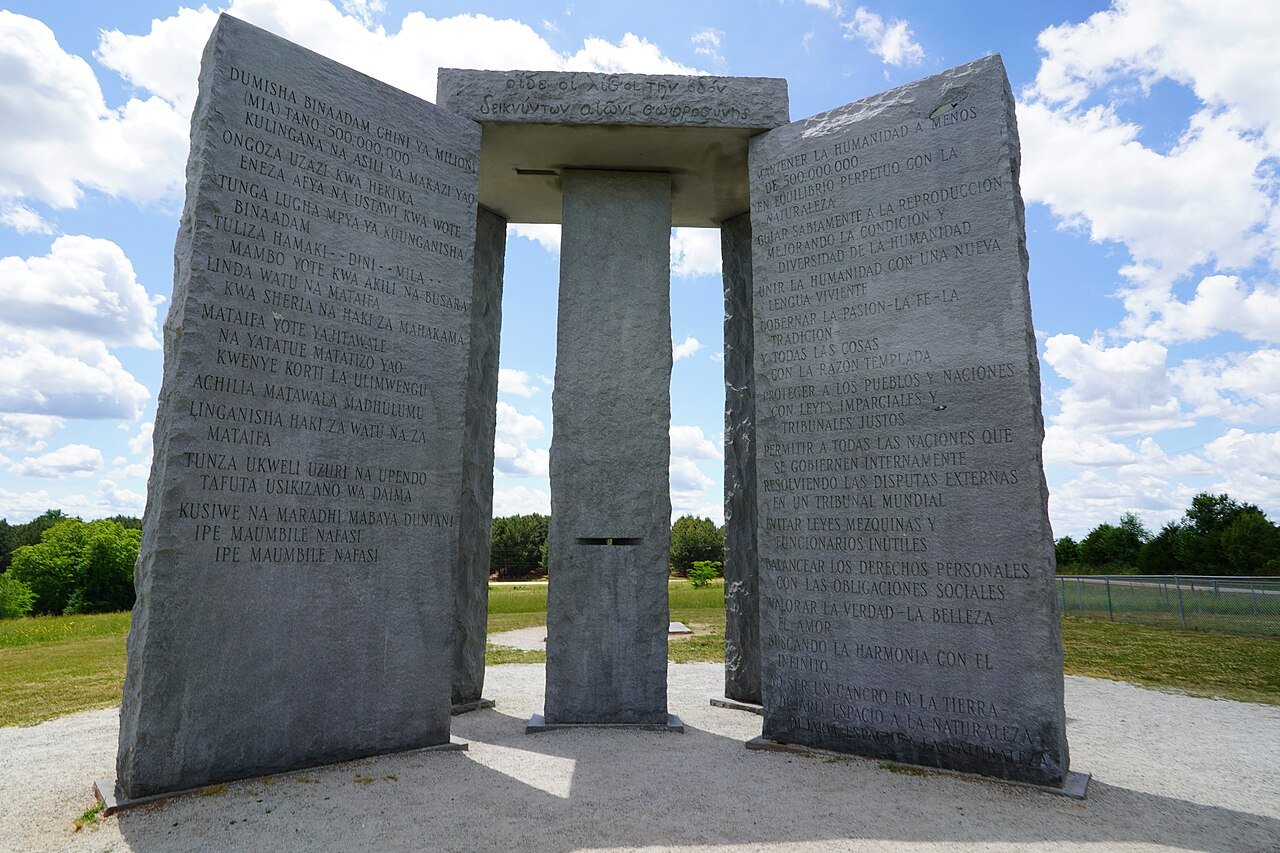
For 42 years a strange granite monument stood on a hilltop in Elbert County, Georgia. Its four great slabs and central column carried ten “guides” in eight languages, the first of which read: “Maintain humanity under 500,000,000 in perpetual balance with nature.” Unsurprisingly, it unsettled people. Over the years it was called the “American Stonehenge”, the “Ten Commandments of the Antichrist” and a blueprint for the New World Order. Some called it “satanic”, and in May 2022 a candidate for governor said she would turn it “into dust”. On 6 July 2022 someone bombed it, and the authorities demolished what was left the same day “for safety reasons”, as PolitiFact reported. Among the many theories about who was really behind it, one says it was the Freemasons.
Who really commissioned the Guidestones?
In June 1979 a well-dressed man walked into the offices of Elberton Granite Finishing and introduced himself as Robert C. Christian, a name he admitted was a pseudonym. He said he represented “a small group of loyal Americans who believe in God” and wanted a giant stone monument that would also work as a compass, calendar and clock. The company’s president, Joe Fendley, later told a reporter that his first thought was that he had “a nut” on his hands, and he quoted a price several times higher than any job his firm had ever done, hoping to scare him off. It did not work. The man was sent to a local banker, Wyatt Martin, who agreed to handle the money and promised never to reveal his client’s real name. The monument was unveiled on 22 March 1980.
So the Guidestones were a private commission from an anonymous customer, carried out by a commercial stone company. In a book published in 1986, Common Sense Renewed, a man writing as Robert Christian said: “I am the originator of the Georgia Guidestones and the sole author of its inscriptions.” He went on: “We have no mysterious purpose or ulterior motives. We seek common sense pathways to a peaceful world, without bias for particular creeds or philosophies.” You do not have to agree with his guides, and many people found some of them disturbing, but nothing in the record connects them to a Masonic lodge.
“R. C.” means Rosy Cross, and that means Masons?
The most popular “secret society” theory is not even about Freemasons. As Wired magazine reported in 2009, the conspiracy writer Jay Weidner argued that Christian and his associates “were Rosicrucians”, reading “R. C. Christian” as a nod to Christian Rosenkreuz, the legendary founder of the Rosy Cross. That is a guess based on a pseudonym, and the skeptic writer Brian Dunning of Skeptoid points out that Rosicrucian teachings bear only minimal similarity to the guides on the stones. It is also worth remembering that the Rosicrucians are not the Freemasons. Turning “Rosicrucian” into “Masonic” requires two leaps, not one. Wired‘s long investigation into the stones does not mention the Freemasons at all.
What about the Masons who carved them?
This is the one detail usually offered as proof. Skeptoid notes: “It’s often noted that Fendley was a 32nd-degree Freemason, and several of his top workers who participated in the Guidestones were also Freemasons in his same lodge.” Its verdict follows straight away: “While this may be intriguing to conspiracy theorists, it is not useful evidence of anything at all.” Elberton is known as the granite capital of the world. If some of the men cutting stone in a small Southern granite town were members of the local lodge, that tells you about small Southern granite towns, not about who paid for the monument or wrote its words. The same goes for the stone itself, a granite called “Pyramid Blue”: according to Skeptoid, it is named after Pyramid Quarries, a local quarry company that Fendley owned.
What individual workmen were in their spare time is not the act of the fraternity. No lodge commissioned the Guidestones, no Masonic body has ever endorsed their guides, and Freemasons are bound to obey the law (see Claim #07). The wider “New World Order” story the stones got wrapped up in has, as PolitiFact notes, “antisemitic origins”. We look at that story in Claim #16.
Conclusion: The Freemasons did not build the Georgia Guidestones. The monument was commissioned in 1979 by an anonymous private client using the name “R. C. Christian”, and made by a commercial granite firm. The “Rosicrucian” theory is a guess based on that pseudonym, Rosicrucians are not Freemasons, and the fact that some local stonecutters may have belonged to a lodge is, as one skeptic put it, “not useful evidence of anything at all”. No Masonic body ever commissioned, funded or endorsed the stones.
Sources:
Robert Christian, Common Sense Renewed (Lake Mills, Iowa: Graphic Publishing Company, 1986), ch. “The Georgia Guidestones”
Randall Sullivan, “American Stonehenge: Monumental Instructions for the Post-Apocalypse”, Wired, 20 April 2009: https://www.wired.com/2009/04/ff-guidestones/
Brian Dunning, “The Georgia Guidestones”, Skeptoid episode 4198, 23 March 2010: https://skeptoid.com/episodes/4198
Madison Czopek, “Bombing of controversial Georgia Guidestones fuels online conspiracy theories”, PolitiFact, 13 July 2022 (quoting the Georgia Bureau of Investigation, 6 July 2022): https://www.politifact.com/article/2022/jul/13/bombing-controversial-georgia-guidestones-fuels-on/