The claim
CLAIM #36:
Jack the Ripper’s murders were Masonic ritual killings, covering up a royal scandal?
FALSE
ANSWER:
The “Masonic Ripper” story comes from one man, who later told The Sunday Times it was “a hoax … a whopping fib”. The alleged Masonic killers were not even Masons.
In the autumn of 1888 five women were murdered in Whitechapel, in the East End of London. The killer was never caught, and “Jack the Ripper” has been a magnet for theories ever since. One of the best known says that the murders were committed by Freemasons, in Masonic fashion, to hide a royal secret, and that a Masonic police chief covered it up. It has been told in books, a graphic novel and several films. Here is where it came from, and why it falls apart.
Where does the story come from?
From a man called Joseph Gorman, who claimed to be the son of the painter Walter Sickert and told his tale in a BBC series in 1973. The journalist Stephen Knight built it into a bestselling book, Jack the Ripper: The Final Solution (1976), which went through 20 editions and inspired the graphic novel From Hell and its film. The story runs like this: Prince Albert Victor, the Queen’s grandson, had secretly married a Catholic shop girl and fathered a child; the Prime Minister, Lord Salisbury, conspired with “his fellow freemasons” to silence the women who knew; and the royal physician Sir William Gull killed them, with the help of a coachman named John Netley. Knight added that Sir Charles Warren, the Commissioner of Police, destroyed evidence to protect his Masonic friends.
Knight himself admitted at the start of his book that “it all sounds terribly unlikely”. As the reviewer in The Times Literary Supplement replied: “It does.”
Does any of it stand up?
Not a single load-bearing part. The “Masonic” plotters were not Masons: according to the historical record, neither Lord Salisbury nor Sir William Gull was a Freemason. Gull could not have done it anyway: he had retired in 1887 after a stroke that left him temporarily partly paralysed and unable to speak. The prince has an alibi: on the night two of the women were killed, he was at Balmoral in Scotland, more than 800 kilometres from London. The coachman Netley did not drown in the Thames as the story says; he died in 1903 after falling under the wheels of his own van. The house in Cleveland Street that was supposedly raided had already been demolished. There is no record of any royal marriage. And the forensic evidence shows that the women’s bodies were not moved, so the “murders in a carriage” never happened.
Then the story lost its only witness. After Knight’s book went on to accuse Walter Sickert himself, Joseph Gorman withdrew his testimony and told The Sunday Times that “it was a hoax … a whopping fib”. Today, “Most scholars dismiss the theory, and the book’s conclusion is now widely discredited.” Even Knight’s friend, the writer Colin Wilson, thought the story “obvious nonsense”, and suggested that Knight “wrote the book with his tongue in his cheek, then found himself caught up in a success that prevented him from retracting or quietly disowning it.”
But wasn’t the police chief a Mason?
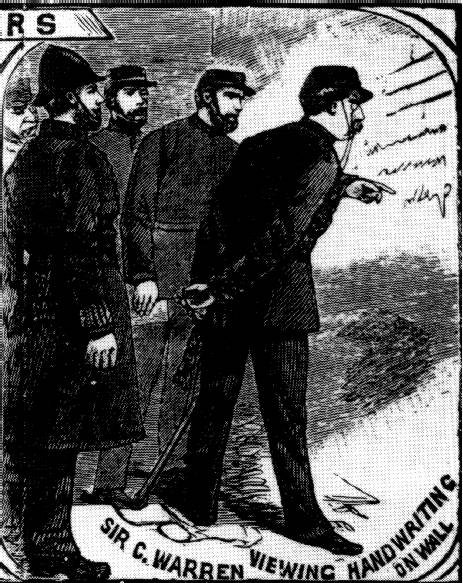
Yes. Sir Charles Warren, Commissioner of the Metropolitan Police from 1886 to 1888, was an enthusiastic Freemason and the founding Master of Quatuor Coronati Lodge, the famous lodge of Masonic research. And he did order a chalked message found near one of the murder sites to be washed away before it could be photographed. Knight claimed that one word in it was a Masonic reference. Warren’s own explanation is on the record: the message mentioned “Juwes”, and he feared that if the words were reported there would be anti-Semitic riots in the East End.
You may think that was a poor decision; many people did, and Punch mocked the police that autumn. But it was one man’s decision, with a stated reason, and it is not evidence of a Masonic murder plot. What an individual Mason does is his own responsibility, not the fraternity’s, and Freemasonry requires its members to obey the law and treats crime as a Masonic offence (see Claim #07). A police chief who happens to be a Mason no more makes a crime “Masonic” than a police chief who happens to be a Methodist makes it Methodist.
Conclusion: The Jack the Ripper murders were not Masonic ritual killings. The story comes from Joseph Gorman, who admitted it was “a hoax … a whopping fib”, and from Stephen Knight’s 1976 book, which scholars widely reject. The alleged Masonic plotters, Lord Salisbury and Sir William Gull, were not Masons, Gull had been disabled by a stroke, the prince was in Scotland, and the coachman died years later in a road accident. Sir Charles Warren was a Mason, and he gave his own reason for wiping away the chalk message; one man’s decision is not a lodge’s plot. The real victims deserve better than a hoax.