The claim
CLAIM #19:
There Are Sexual Connotations To Masonic Symbols in The “G” within the Square & Compass?
FALSE
ANSWER:
The “G” stands for God and for Geometry, and Masons have said so openly, in print, for nearly three hundred years. The only thing it has ever had to do with sex is the imagination of the people making this claim.
The letter G is one of the best-known symbols of Freemasonry. It hangs in the East of almost every lodge in the English-speaking world, and it sits in the middle of the square and compasses on rings, car badges and lodge signs. Because it is so familiar, it has attracted more than its share of strange theories, and one of the strangest is that it hides a sexual meaning. It does not, and the reason we can say so with confidence is that its meaning has never been a secret.
What the G stands for
The earliest known explanation of the G comes from 1730, in Samuel Prichard’s Masonry Dissected, which records this exchange from the Fellow Craft degree:
“Why was you made a Fellow-Craft? For the sake of the Letter G. What does that G denote? Geometry, or the fifth Science.”
Samuel Prichard, Masonry Dissected (1730), as reproduced in Harry Carr, World of Freemasonry
Geometry was at the heart of the stonemasons’ craft. The oldest Masonic document of all, a poem written around 1390, says that “thru good wit of geometry / Began first the Craft of Masonry”. Later the G also came to be read as the initial of God, the Great Architect of the Universe. Masonic writers have published both meanings openly ever since. William Hutchinson wrote in The Spirit of Masonry in 1776 that “this significant letter denotes Geometry”, the science that shows “the order, beauty, and wonderful wisdom of the power of God in His creation”. In 1801 the American Freemason Frederick Dalcho said the same: the G is “expressive of the name of the Grand Architect of the universe” and “also denotes the science of Geometry”.
The American Masonic scholar H. L. Haywood explained why the two meanings sit so comfortably together:
“The two conceptions merge naturally because men have always seen in the Geometry which is everywhere found in nature the clearest unveiling of the Infinite Mind.”
H. L. Haywood, Second Steps, “The Letter G”
And Mackey’s Encyclopedia of Freemasonry makes the key point: the meaning of the G “is by no means, and never has been, esoteric”. It is on display in every lodge, and Masonic authors have always explained it “openly and in the plainest language”. There is no hidden second meaning waiting to be uncovered.
So where does the “sexual” idea come from?
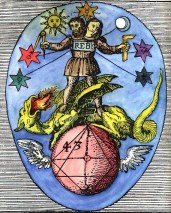
To be fair to the people who repeat this claim, it did not come entirely from nowhere, and it is better to explain it honestly than to pretend otherwise.
In the nineteenth century, many writers, Masonic and otherwise, were fascinated by theories that all ancient symbols had once been fertility symbols. Albert Mackey, the American Masonic author, was one of them. Writing about an old alchemical woodcut from Basil Valentine’s book Azoth, which shows a two-headed figure, half man and half woman, holding a compass in one hand and a square in the other, Mackey speculated: “The Square and Compasses thus distributed seem to indicate that originally a phallic meaning was attached to these symbols.”
Notice what that actually is. It is one writer’s guess about where an alchemist’s picture might have come from, a century before Freemasonry’s first Grand Lodge was formed in 1717. It is not Masonic teaching, it does not appear in any Masonic ritual, and the woodcut does not even contain a letter G.
That did not stop opponents of Freemasonry from seizing on it. In 1908 the Catholic writer Arthur Preuss reprinted Mackey’s speculation in A Study in American Freemasonry, and the author of the article on Freemasonry in the Catholic Encyclopedia went further and charged Masons with “phallic worship”. From there the idea passed into modern anti-Masonic tracts, which now announce that Masonic symbols “have sexual connotations!” and quote one another as proof. A passing guess by a Victorian author has been turned into a “secret” that Freemasons supposedly hide.
What a Freemason is actually taught
When a Fellow Craft is introduced to the letter G, he is told about Geometry, the science on which the builder’s art rests, and through it about God, the Great Architect, whose order can be seen in the design of the universe. Haywood summed up the lesson beautifully: when men learn to live by the same orderly laws they see in nature, “they will discover that the face of God has been made plain—they will have learned the secret of the letter G.”
That is the whole “secret”. It is printed in books, explained in lodges and has been public for nearly three centuries.
Conclusion: The letter G in the square and compasses stands for God and for Geometry, as Masonic sources have said openly since at least 1730. The “sexual” reading began as one nineteenth-century author’s speculation about an alchemical woodcut that has no G in it, and was then taken up and exaggerated by Freemasonry’s opponents. It has never been part of Masonic teaching. The claim is false, and, as the original draft of this page put it, more than a little hilarious.
Sources:
Samuel Prichard, Masonry Dissected (London, 1730), as reproduced in Harry Carr, World of Freemasonry: Six Hundred Years of Craft Ritual
H. L. Haywood, Second Steps, Part X, “The Letter G” (Iowa)
Mackey’s Encyclopedia of Freemasonry, entries “G” and “Talisman”
William Hutchinson, The Spirit of Masonry (1776), Lecture VIII
Arthur Preuss, A Study in American Freemasonry (St. Louis, 1908)
https://commons.wikimedia.org/wiki/File:Azoth-Sixth_woodcut.jpg