
The Noachite, or Prussian Knight, is one of the oddest degrees in the Scottish Rite, and one of the most reworked. It began as a legend about the Tower of Babel and the descendants of Noah, quite separate from the Temple of Solomon that runs through most of the Rite. Albert Pike replaced that story with a courtroom drama set in a secret tribunal of medieval Germany, and turned the degree into a lesson on humility, honest judgment and the value of an independent judiciary.
The degree at a glance
- Number and title: 21st degree, Noachite, or Prussian Knight, the title used in the Southern Jurisdiction (S.J.) and in Scotland. The Northern Masonic Jurisdiction (N.M.J.), France, Canada, and England and Wales call it Patriarch Noachite.
- Body: the Council of Kadosh in the S.J.; the Consistory in the N.M.J., where the degree shows knights and nobles joining together to punish crime, reward virtue, protect the innocent and help the needy, with the lesson that Freemasonry is no shield for wrongdoing.
- Setting (S.J.): a nocturnal tribunal of the Vehmgericht, the secret courts of medieval Westphalia.
- Name: “Noachite” means a descendant or disciple of Noah. Mackey records that members of the old degree called themselves Noachites and called all other Masons “Hiramites”, after Hiram Abif.
According to Mackey, the early French rituals claimed the degree had been translated from German in 1757, a claim the German scholar Lenning did not believe. Its original legend followed Peleg, the master builder of the Tower of Babel, on his wanderings after the confusion of tongues, and its meetings were held on the night of the full moon without any artificial light. Hutchens notes that it was subtitled “the Masonic Key” in Étienne Morin’s Order of the Royal Secret. The degree passed into the Scottish Rite through the Council of Emperors of the East and West, but Mackey thought it badly out of place in a series built on Solomon’s Temple, calling it “an unsightly interruption of the chain of legendary symbolism.”
The lesson
Pike recognised the problem and rebuilt the degree around a different institution altogether. The Vehmgericht was a system of secret courts that flourished in medieval Germany. Its judges, the Freischöffen, had to prove they were freeborn, of good family and blameless character, and at its height the association counted thousands of members, from princes to commoners. It met at night, judged and punished without being answerable to anyone, and in time, as Pike observes, power without publicity or accountability was abused by unworthy members and the courts fell into decline by the end of the fifteenth century. Hutchens suggests two reasons for Pike’s choice: he was a self-taught lawyer who practised in Arkansas and New Orleans and cared deeply about the history of law, and a medieval court fitted the chivalric setting of the Council’s other degrees far better than the Tower of Babel. Only a trace of the old legend survives, in a reminder of the fate of Peleg and the builders of Babel, whose pride was humbled.
In the drama the lodge becomes a tribunal whose members are masked, a reminder that we never know the true character of those who judge us, nor the hour of our own judgment. A crusader, Adolf the Saxon, returns from the Holy Land to find that his lands have been taken from him by means of a forged deed, and he appeals to the tribunal for justice against a powerful count who sits among its judges. With only the word of one man against another, the case passes through the medieval forms of proof: trial by oath and then trial by ordeal. Before it can go to trial by combat, the deed is proved to be a forgery.
The count represents everything a Mason should not be: bold in his guilt and ready to deny it before God. The Mason is to be the opposite, humble and modest and trusting in God, confident that although evil may prosper for a while its downfall is certain. Hutchens draws out two further lessons that reflect Pike’s own career as a lawyer and a former newspaper editor: a free and independent judiciary, open to the weakest as well as the strongest, is essential to human progress; and the press, as the “protecting check of publicity”, must be fair, just and responsible.
Duties of the degree
A Bridge to Light sets out two duties for a Noachite:
- to be humble and modest, trusting in God;
- to be steadfast and courageous in the face of adversity.
Pike’s lecture adds a strong warning against slander. A Mason should be slow to think ill of others, reluctant to attribute bad motives to them, and unwilling to pile further disgrace on anyone who has already fallen.
Symbols and regalia
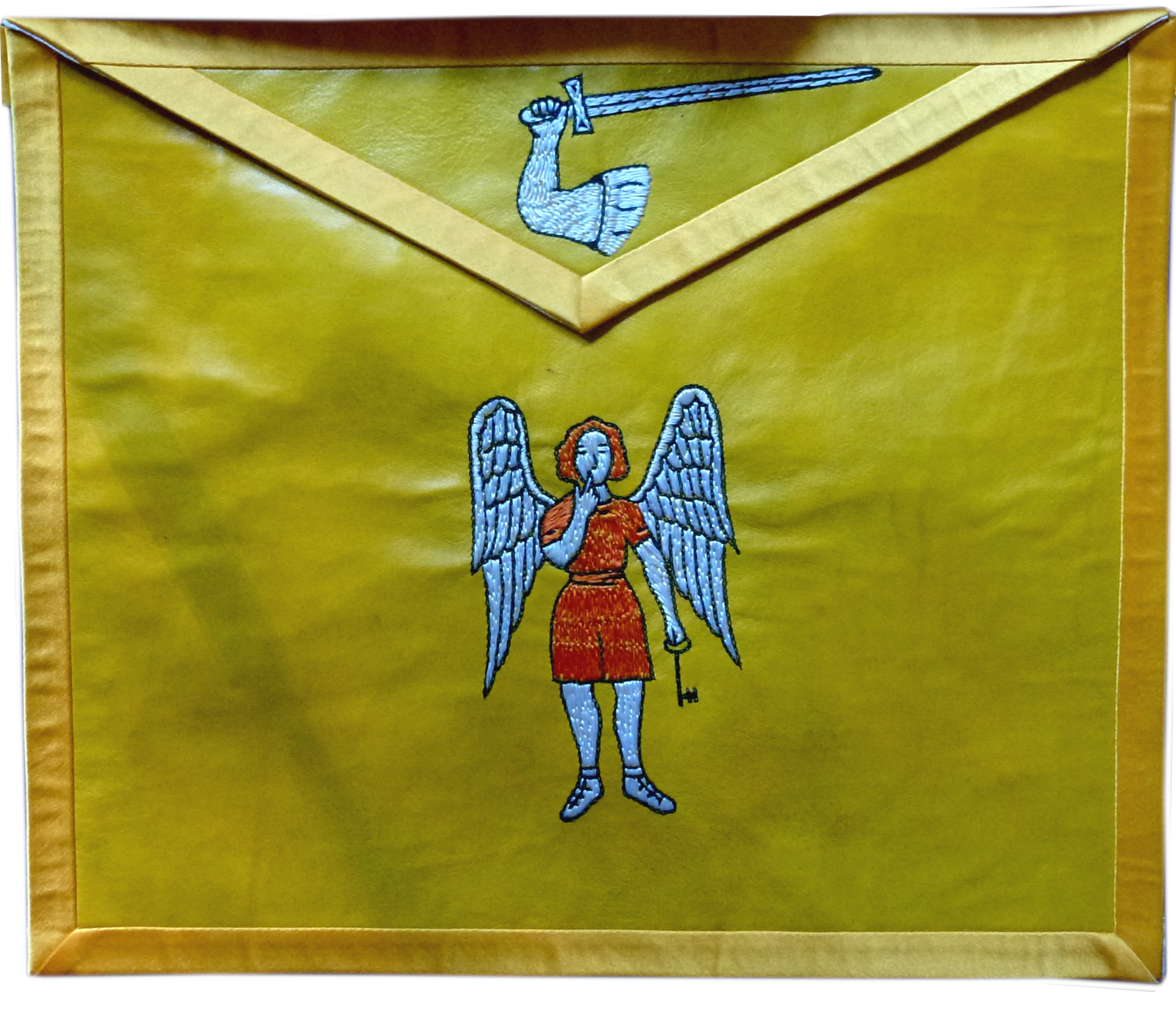
The apron and gloves of this degree are yellow. On the upper part of the apron is a bare arm raised and holding a drawn sword. Beneath it is a standing winged figure with the forefinger of his right hand on his lips and a key in his left: the Egyptian figure of silence whom the Greeks called Harpocrates. Hutchens notes that the wings are a later addition; Plato said that wings stood for intelligence.
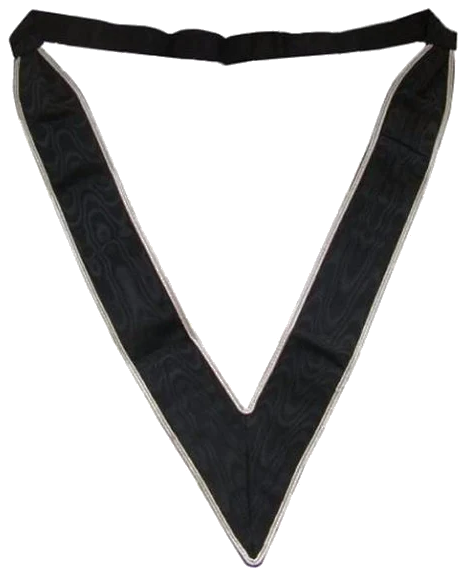
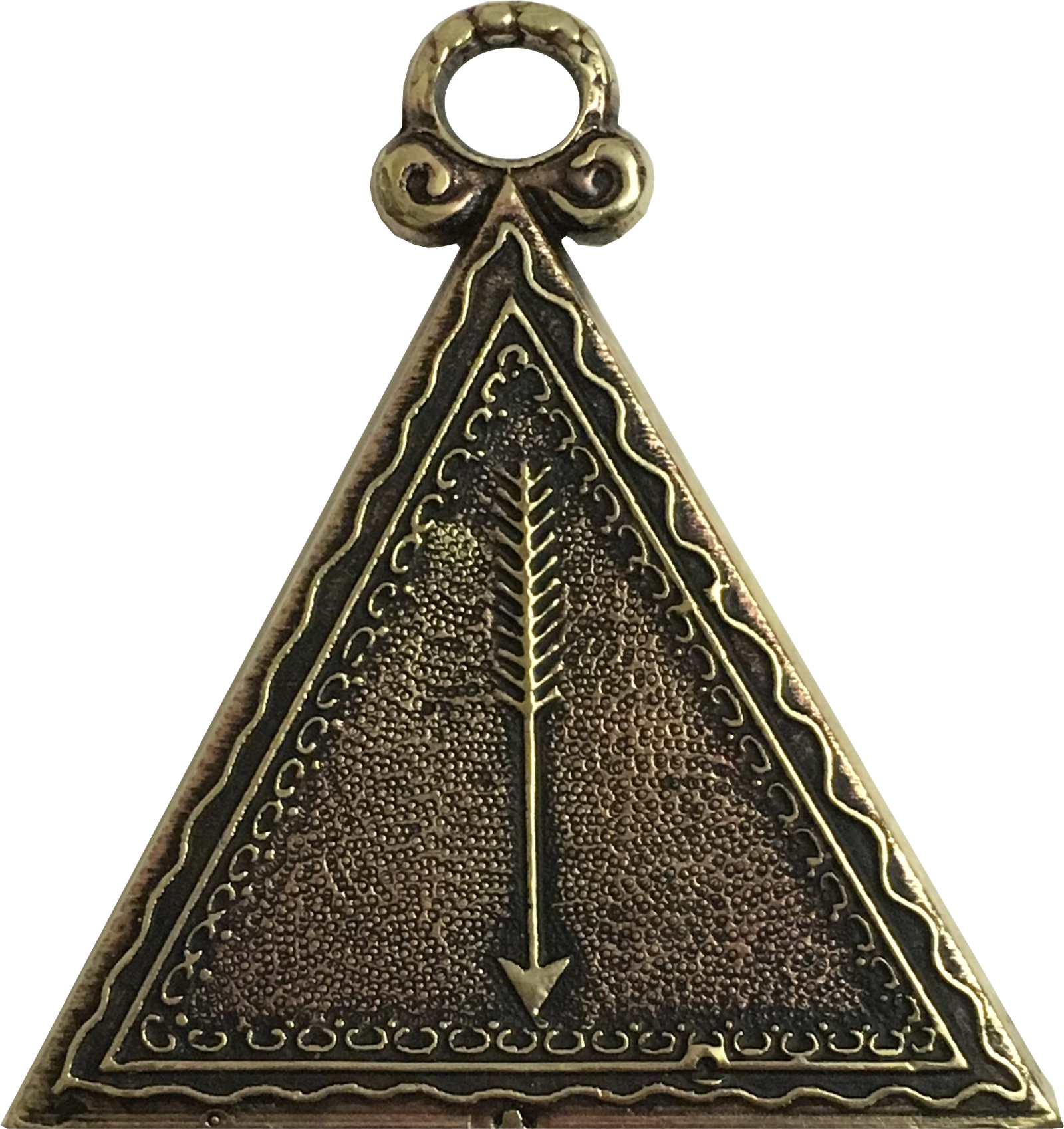
The order is a broad black ribbon worn from right to left. The jewel may be a silver full moon or, as in the picture on this page, a golden triangle pierced by an arrow pointing downward. On the jewel is an arm holding a sword, with the motto Fiat Justitia, Ruat Coelum: “Let justice be done, though the heavens fall.” Hutchens attributes the words to William Murray, first Earl of Mansfield, Lord Chief Justice of England, in the case of Rex v. Wilkes in 1768.
The important symbols of the degree, according to Hutchens, are the masked brethren, the full moon and the sword of a knight.
Reflections
The heart of Pike’s lecture is a plea for modesty, both towards God and towards other people:
“You are especially charged in this Degree to be modest and humble, and not vain-glorious nor filled with self-conceit. Be not wiser in your own opinion than the Deity, nor find fault with His works, nor improve upon what He has done.”
Albert Pike, Morals and Dogma, 21° Noachite, or Prussian Knight
On how a Mason should speak of others, he offers a rule that is as useful outside the lodge as in it:
“If there be virtues, and he is called upon to speak of him who owns them, let him tell them forth impartially. And if there be vices mixed with them, let him be content the world shall know them by some other tongue than his.”
Albert Pike, Morals and Dogma, 21° Noachite, or Prussian Knight
Rex Hutchens leaves one question for every member: do you keep the ideal of justice before your own interests?

Please view the video on the left, for a more detailed explanation of the 21st° Degree.
Sources:
– Rex R. Hutchens, A Bridge to Light: The Revised Standard Pike Ritual, 4th ed., ed. Arturo de Hoyos (Supreme Council, 33°, S.J., 2010): chapter “The 21st Degree – Noachite or Prussian Knight”. Purchase A Bridge To Light by Rex R. Hutchens
– Albert Pike, Morals and Dogma (1871): chapter XXI, “Noachite, or Prussian Knight”. Purchase Morals & Dogma by Albert Pike
– Albert G. Mackey, Encyclopedia of Freemasonry: entry “Noachite, or Prussian Knight”
– Albert Pike, Legenda XIX–XXX and Legenda XXXII, as quoted in A Bridge to Light
– Scottish Rite, N.M.J., “The Consistory” (21° Patriarch Noachite): https://scottishritenmj.org/subordinate-bodies/consistory
– Wikipedia, “Scottish Rite” (degree names by jurisdiction)