 History
Freemasons have always counted their story in long years. Many Masonic documents are dated not only in the common era but in the “Year of Light”, which places the beginning of the Craft’s reckoning about six thousand years ago. This chapter follows that story from the first temple builders of Sumer and Egypt, through the Tabernacle and King Solomon’s Temple, the Knights Templar and the cathedral builders, to the Grand Lodges and the worldwide Craft of today. Along the way it marks clearly what the stones and the records show, and what the Craft’s own tradition has handed down.
Counting from the Year of Light
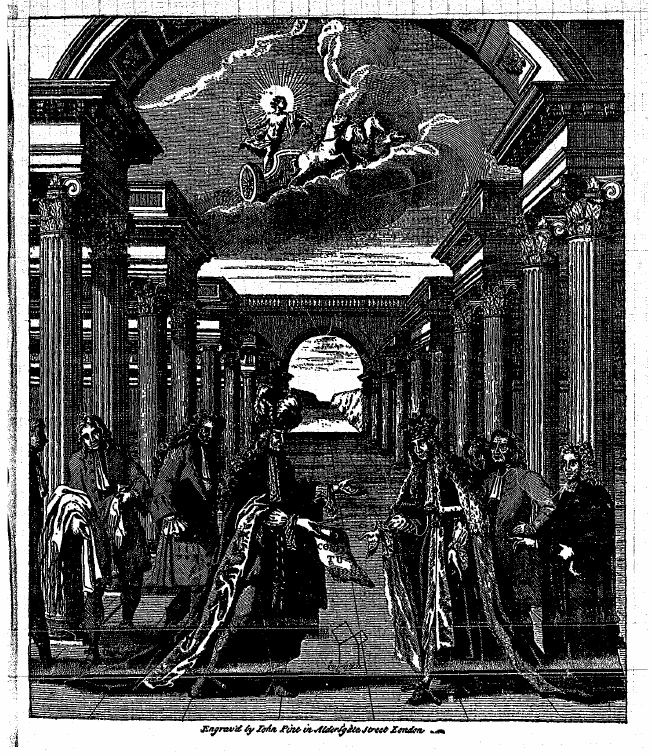
Albert G. Mackey’s Encyclopedia of Freemasonry explains the Masonic era of Anno Lucis, “meaning in the Year of Light”. It is “The date used in ancient Craft Freemasonry; found by adding 4000 to the Vulgar Era”. The year 2026 is therefore 6026 A.L. The custom is old: the title page of the first Constitutions of the Freemasons, printed in London in 1723, is dated “In the Year of Masonry” 5723 as well as Anno Domini 1723.
The figure of four thousand years before the common era comes from the Bible chronology of the time, made famous by Archbishop James Ussher, who placed the Creation in 4004 B.C. The other Masonic bodies keep their own eras: the Royal Arch counts from the rebuilding of the Temple (530 B.C.), the Royal and Select Masters from the dedication of Solomon’s Temple (1000 B.C.), and the Knights Templar from the founding of their Order (A.D. 1118). For Freemasons the Year of Light is a symbol: the Craft’s story is the story of light coming into the world, and of men learning to build.
The first sacred builders: Sumer
The oldest written account of a building ceremony comes from ancient Sumer, in what is now southern Iraq. Around 2125 B.C., Gudea, ruler of the city of Lagash, built a great temple for his god Ningirsu and had the whole story written on two clay cylinders. In a dream, Gudea sees a divine architect: “There was, furthermore, a warrior. His arm was bent, holding a lapis lazuli tablet in his hand, and he was setting down the plan of the house.” The temple begins with a single sacred brick: “Gudea placed the clay into the brick mould and acted exactly as prescribed, bringing the first brick of the house into existence in it, while all the bystanders sprinkled oil or cedar perfume.”
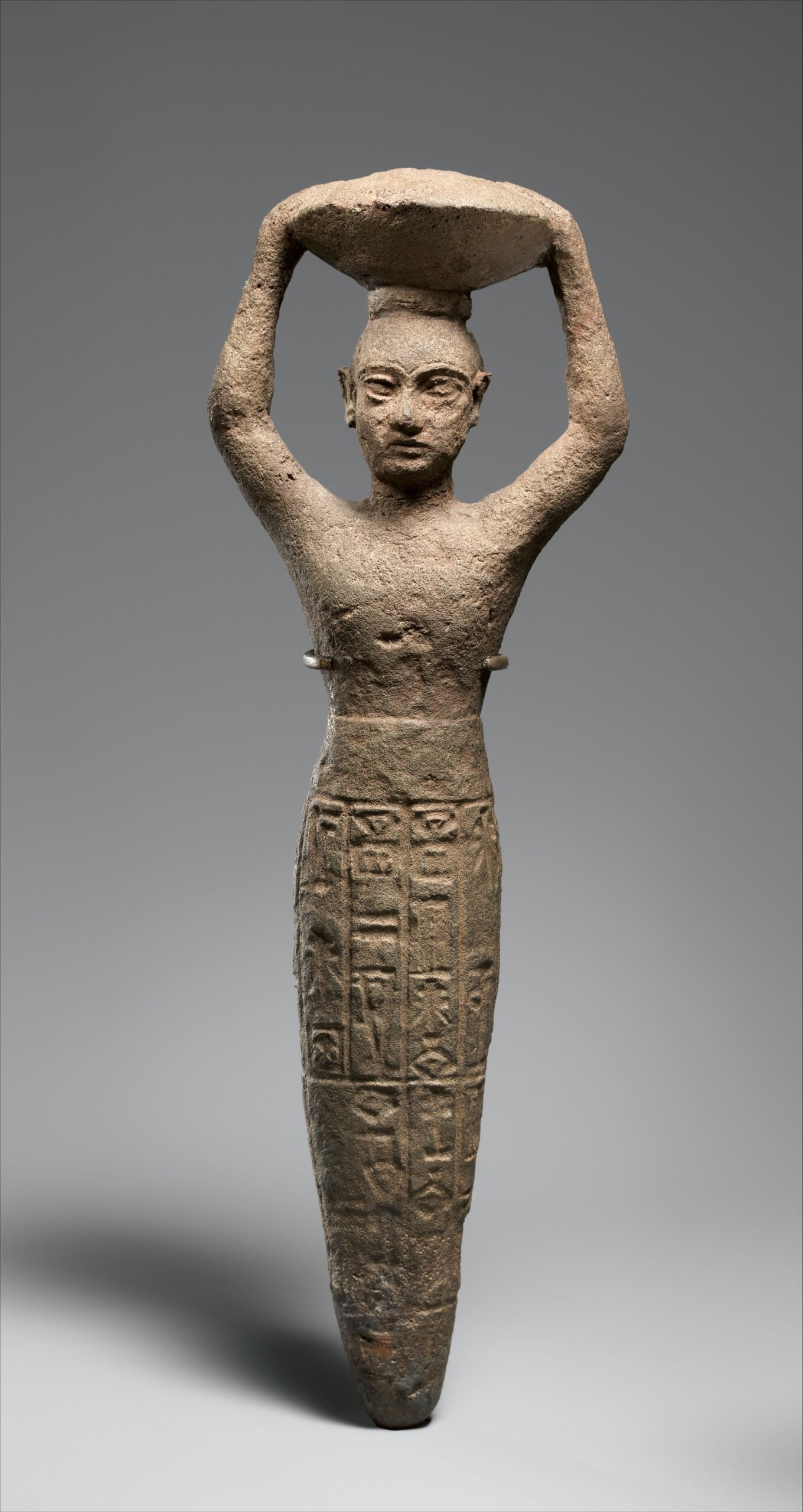
A famous statue of Gudea in the Louvre, known as the “architect with plan”, shows him seated with the plan of a building on his lap. The Sumerians honoured gods of the builder’s craft: Kulla, the god of bricks, and Mushdamma, the god of foundations, alongside Enki, the god of wisdom and the crafts. Their kings were shown as builders too. A stone stele of King Ur-Nammu of Ur, now in the Penn Museum, shows the king, in the words of the archaeologist Leon Legrain, “shouldering the mason’s tools” as “he goes to lay the foundation brick. Workers carry baskets of mud and climb ladders to the top of the wall.”
The Craft’s own oldest documents remember this land. The Cooke Manuscript, written in England around 1450, tells the story of Nimrod and the building of the tower of Babel as part of the legendary history of masonry. That story is tradition rather than history, but the clay cylinders of Gudea show that four thousand years ago a builder’s work was already a sacred work, begun with a plan, a measure and a consecrated first stone.
India: Vishvakarman and the master builders
In India the builder’s craft also has a divine patron. The hymns of the Rig Veda (book 10, hymns 81 and 82) praise Vishvakarman, the “All-Maker”, the divine craftsman who shaped heaven and earth. Indian builders and craftsmen honour him to this day.
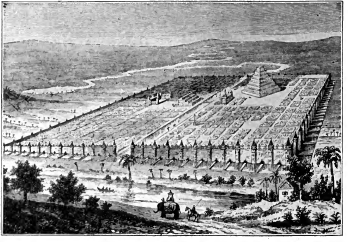
The classical Indian treatises on architecture, such as the Manasara (dated to the fifth century A.D. or earlier), describe a guild of builders led by the sthapati, the master architect, with the sutragrahin who holds the measuring cord, the vardhaki who works the stone and the takshaka who works the wood. Far older still are the planned cities of the Indus Valley, such as Mohenjo-daro and Harappa (about 2600 to 1900 B.C.), laid out on a grid and built of fired brick; one common Mohenjo-daro brick size follows a proportion of about 1:2:4. Master, measurer and workmen, the plan and the measure: the same pattern of the builder’s craft appears across the ancient world.
A Freemason of India has drawn the same thread through the temples of his own country. R.W.Bro. Bharat V. Epur, OSM, Past Deputy Grand Master of the Grand Lodge of India, writes in his paper Demystifying Freemasonry: To the Profane and the Initiate (2021) that “Freemasonry is marked by two principal concerns, the search for more Light, and Temple building.” He finds that link “further demonstrated in India’s architectural discipline of Vaastu Shastra. According to the principles of Vaastu, a sacred structure such as a temple is designed to be not just the residence of a god, but the actual body of Deity.” Every Hindu temple begins with the Mandala Purusha, the cosmic body laid over the building site, its head to the north-east, where the rising sun brings the most light; that corner is called “God’s Corner (isha-kona)”. In his words, “A Hindu temple is a divine and yogic representation of a human being”, and, he adds, “The Temple of Solomon also speaks of the Temple of the human body.”
Michael A. Cremo, the archaeological researcher, points to evidence that India’s building history may reach much further back than the textbooks allow. Writing of the sunken city found in the Gulf of Cambay in 2002, he notes that a piece of wood “from the site yielded a radiocarbon date of about 9,500 years”, and he adds that “the Puranas record the existence of Vedic civilization in India going back hundreds of thousands, even millions of years.” (The Forbidden Archeologist)
The researcher Praveen Mohan has spent years filming India’s ancient temples. He observes that “most Hindu temples are just simple pyramids”, and that the tower of the Kailasanathar temple at Kanchipuram “looks like a normal step pyramid”. At Ahichchhatra in Uttar Pradesh he points to “a pyramid built by the father of Draupadi”, which he says “was built during the Mahabharata”. Of the great Kailasa temple at Ellora, carved down from a single hill of rock, he notes that “over 400,000 tons of rock had to be scooped out”, in what historians think was less than eighteen years.
Egypt: the pyramid builders
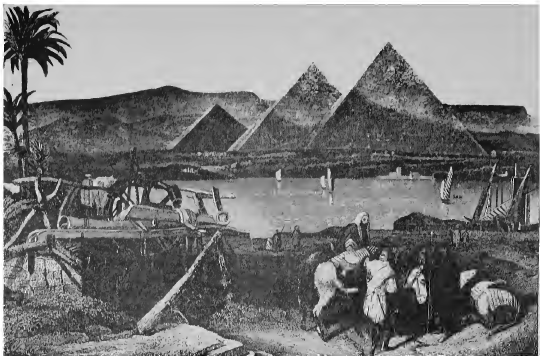
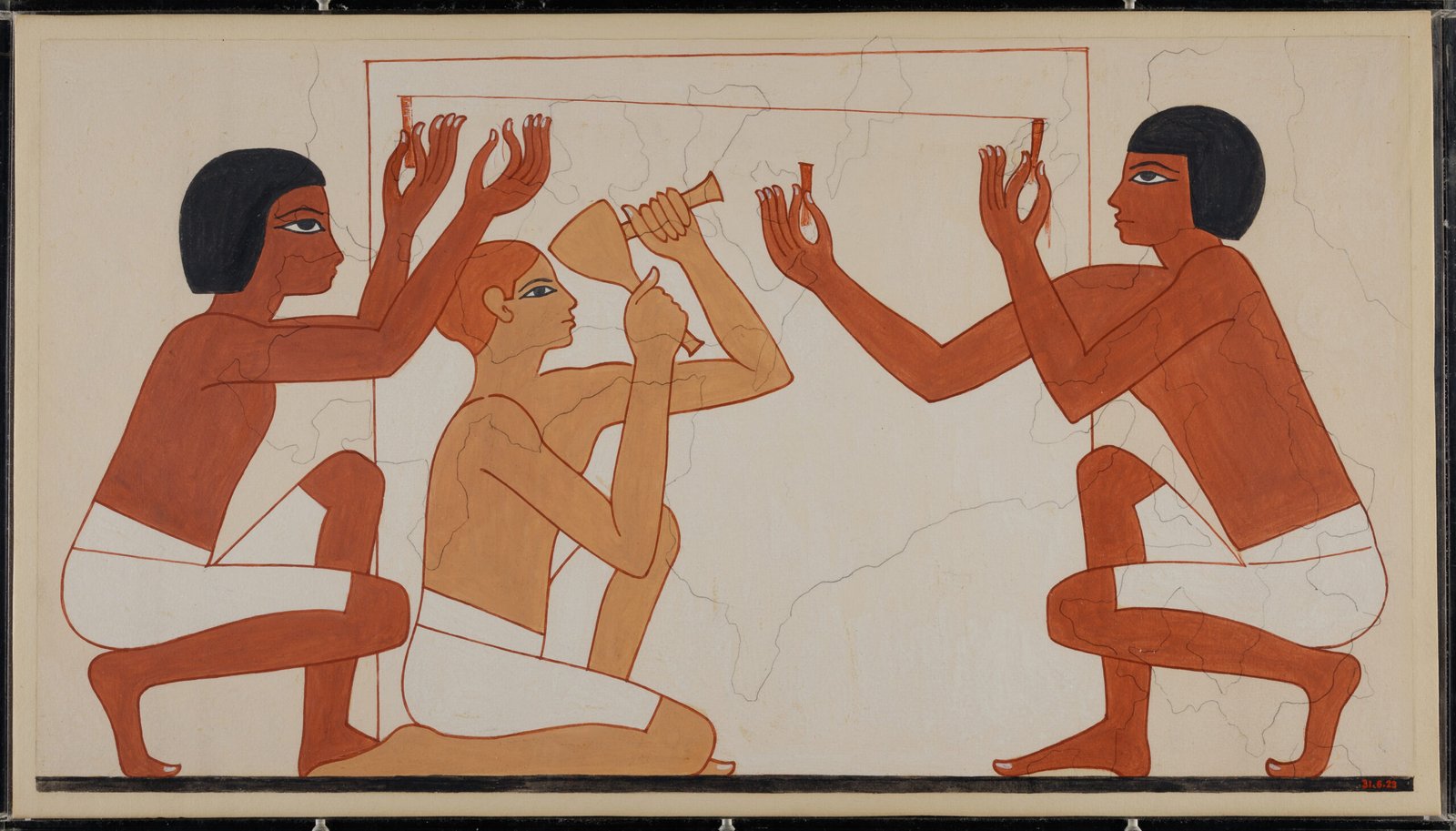
Egypt has always held a special place in the hearts of Freemasons. Its temples and pyramids are among the greatest works of the builder’s art, and the Egyptian builders worked with the very tools the Craft still holds dear. The tomb of Sennedjem, a craftsman of Deir el-Medina, the village known as Set Maat, the Place of Truth, held the implements of his trade: “Some of the tools that Sennedjem probably used during his lifetime, a cubit rod, a right angle and a plumb level, were among the many articles found in his tomb.” The square, the plumb and the measuring rod were already honoured tools thousands of years ago.
Their work was guided by the ideal of Maat, which the Grand Egyptian Museum defines in words every Mason will recognise: “The word covers notions such as order, justice and truth, and means the opposite of chaos, evil (‘isfet’) and lies.” Their temples were laid out with the measuring cord, in a sacred foundation rite called the stretching of the cord.
Egypt also gave the Craft one of its oldest legends. The Old Charges tell how the great geometer Euclid taught the sons of the Egyptian nobility: “they took their sons to Euclid to govern them at his own will, and he taught to them the craft, masonry, and gave it the name of geometry”. Mackey reminds us of the spirit in which Freemasons look back to Egypt: today “we build neither a visible Solomonic Temple nor an Egyptian pyramid”, but a temple of character.
The Tabernacle in the wilderness
Before there was a Temple in Jerusalem there was a tent: the Tabernacle that Israel carried through the wilderness. The Torah names its master builder: “See, I have called by name Bezalel the son of Uri, the son of Hur, of the tribe of Judah; and I have filled him with the spirit of YHWH (יְהֹוָה) the Elohim (אֱלֹהִים), in wisdom, and in understanding, and in knowledge, and in all manner of workmanship” (Exodus 31:1-3). Bezalel was also a teacher: “And He hath put in his heart that he may teach, both he, and Oholiab” (Exodus 35:34).
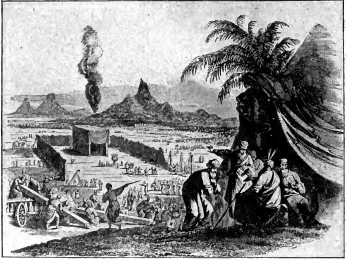
Anderson’s Constitutions of 1723 includes Bezaleel and Aholiab in the Craft’s history, and the picture of the master who teaches the art to others is at the heart of the Masonic tradition of master and apprentice.
King Solomon’s Temple
No building means more to Freemasons than the Temple that King Solomon built in Jerusalem. The Bible dates its foundation “in the four hundred and eightieth year after the children of Israel were come out of the land of Egypt, in the fourth year of Solomon’s reign” (1 Kings 6:1), and it took seven years to build (1 Kings 6:37-38). Scholars place Solomon’s reign in the tenth century B.C.
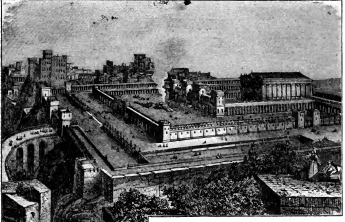
It was a work of many builders. “And Solomon’s builders and Hiram’s builders and the Gebalites did fashion them, and prepared the timber and the stones to build the house” (1 Kings 5:32); the Gebalites, men of Byblos, are the “stonesquarers” of the King James Version. The stones were prepared before they reached the site, in the words Freemasons know from the King James Bible: “And the house, when it was in building, was built of stone made ready before it was brought thither: so that there was neither hammer nor axe nor any tool of iron heard in the house, while it was in building” (1 Kings 6:7).
Hiram, King of Tyre, sent cedar and craftsmen, and from Tyre came the master worker in bronze: “He was the son of a widow of the tribe of Naphtali, and his father was a man of Tyre, a worker in brass; and he was filled with wisdom and understanding and skill, to work all works in brass” (1 Kings 7:13-14). The Book of Chronicles calls him Huram avi, “Huram my master craftsman” (2 Chronicles 2:12-13, 4:16), and from that Hebrew phrase comes the Masonic name Hiram Abif. Before the porch he set up two bronze pillars: “and he set up the right pillar, and called the name thereof Jachin; and he set up the left pillar, and called the name thereof Boaz” (1 Kings 7:21).
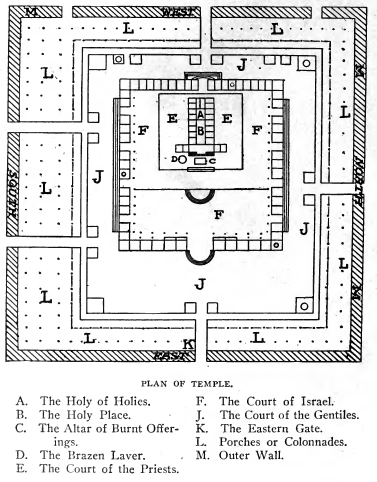
No stone of Solomon’s Temple has been identified, because the Temple Mount cannot be excavated, but its plan matches temples of the same age found elsewhere in the region, such as the temple at ‘Ain Dara in Syria. For the Craft, the Temple has been the model building since long before 1717. The Cooke Manuscript already tells of Solomon’s builders, and the 1723 Constitutions give the numbers of the craftsmen at work. The historian David Stevenson notes that the Old Charges’ lore “was to make a significant contribution to freemasonry through its emphasis on morality, its identification of the mason craft with geometry”.
The Mysteries and the builders of the ancient world
How did the knowledge of the ancient builders reach the masons of medieval Europe? Masonic writers of the eighteenth and nineteenth centuries offered many answers, and they are part of the Craft’s history in their own right:
- The Ancient Mysteries. Writers such as William Hutchinson saw Freemasonry as heir to the Mysteries of Egypt, Eleusis and Mithras. Mackey found striking resemblances between them but no line of descent, and Joseph Fort Newton spoke of a spiritual rather than an organisational descent.
- Pythagoras. The Old Charges honour Pythagoras, and Mackey notes that his school was “much resembling that subsequently adopted by the Freemasons”. The document that once made him a founder of the Craft, the so-called Leland-Locke manuscript, is no longer accepted as genuine.
- The Dionysian Artificers. Sir David Brewster proposed in 1804 that a fraternity of builders of Tyre, devoted to Dionysus, raised Solomon’s Temple and carried their craft across the ancient world. Mackey accepted that the builders of Tyre were real but found no warrant for the rest.
- The Roman Collegia and the Comacine Masters. Rome organised its craftsmen in colleges, and in northern Italy the Comacine Masters are named in the laws of the Lombard kings Rothari (643) and Liutprand (713). Leader Scott’s The Cathedral Builders (1899) traced the medieval guilds back through them; she admitted there was “no certain proof”, and Newton favoured the idea without calling it established.
Manly P. Hall, who later became a Freemason himself, gathered the tradition that the Craft descends from the Mysteries of the ancient world. In The Secret Teachings of All Ages (1928) he writes that “The Dionysiac Architects constituted an ancient secret society, in principles and doctrines much like the modern Freemasonic Order. They were an organization of builders bound together by their secret knowledge.” In The Lost Keys of Freemasonry he calls the Craft “the oldest of the Mystery Schools”.
These links remain theories rather than proven history. What they show is how naturally Freemasons have always seen themselves as heirs of every great building tradition of the past.
The Knights Templar
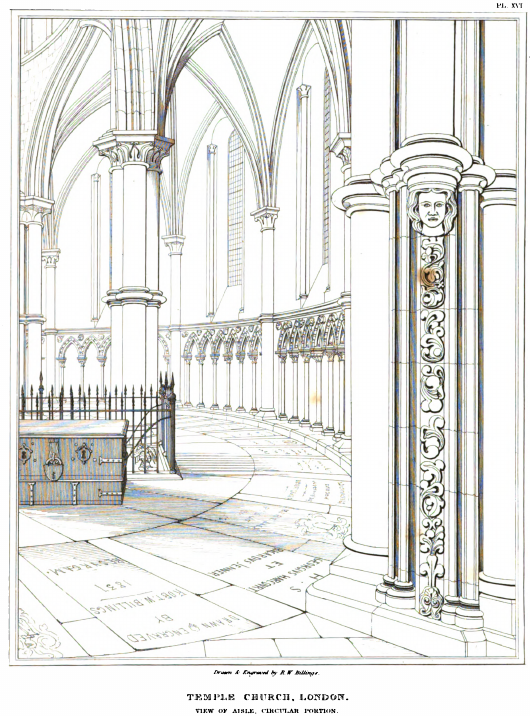
No medieval order is more closely bound up with Freemasonry in the popular mind than the Knights Templar. The Catholic Encyclopedia records their beginning: “In 1118, during the reign of Baldwin II, Hugues de Payens, a knight of Champagne, and eight companions bound themselves by a perpetual vow, taken in the presence of the Patriarch of Jerusalem, to defend the Christian kingdom.” The Temple Church in London, built by the Order, tells why they took their name: their headquarters was “the Aqsa Mosque on the Temple Mount in Jerusalem, believed by the crusaders to be the Temple of Solomon; so they became known as the ‘fellow soldiers of Christ and of the Temple of Solomon in Jerusalem’, or Templars.”
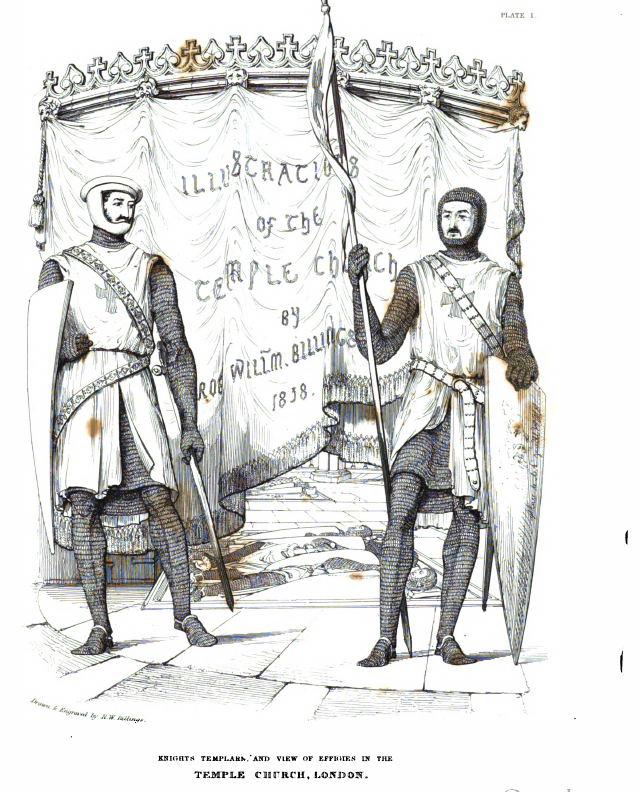
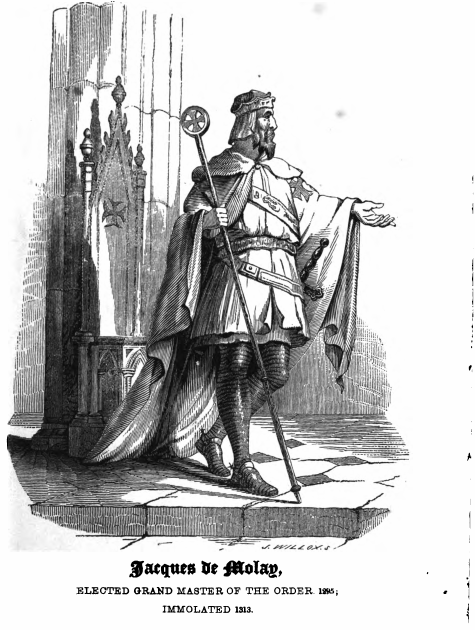
The Order received its Rule at the Council of Troyes (1128), grew rich and powerful across Europe and built preceptories and round churches, among them the Temple Church in London, consecrated in 1185. Its fall was sudden. On 13 October 1307 King Philip IV of France had every Templar in his kingdom arrested on the same day. Pope Clement V dissolved the Order by a bull of 22 March 1312, and the last Grand Master, Jacques de Molay, was burned in Paris in March 1314.
The trial that destroyed the Order rested on confessions, and the Catholic Encyclopedia records that to obtain them torture “was pitilessly employed”. Outside France the verdict was very different: in Portugal, Spain, Germany and Cyprus the Templars were found innocent. When the Order was dissolved its property passed to the Knights Hospitaller, and in Portugal to a new Order of Christ. At the end, on a platform before Notre-Dame, Jacques de Molay withdrew his confession and “proclaimed the innocence of the Templars and the falsity of his own alleged confessions”, knowing it would cost him his life. As the same encyclopedia says, “This brave death deeply impressed the people.”
The link between the Templars and Freemasonry was first made in the eighteenth century. The Chevalier Ramsay’s famous oration of 1737 traced the Craft to the Crusader knights, and the German Rite of Strict Observance of the 1750s taught that the Templars had survived in secret. Scottish legends told of Templars fighting for Robert the Bruce at Bannockburn in 1314, and of knights who fled to Scotland and hid among the masons. Masonic historians examined these stories closely: Mackey called the Bannockburn story “pure myth”, and in 1782 the Convent of Wilhelmsbad itself set aside the claim of Templar descent. Yet the Templar tradition lives on with honour in the Craft. Masonic Knights Templar bodies are recorded from the 1780s, at Bristol by 1780 and in the Grand Conclave under Thomas Dunckerley in 1791, and in the United States the Grand Encampment of Knights Templar was formed in 1816. The Templar orders of Freemasonry carry the ideals of the old Order, its devotion and its chivalry, to this day.
The cathedral builders and the Old Charges
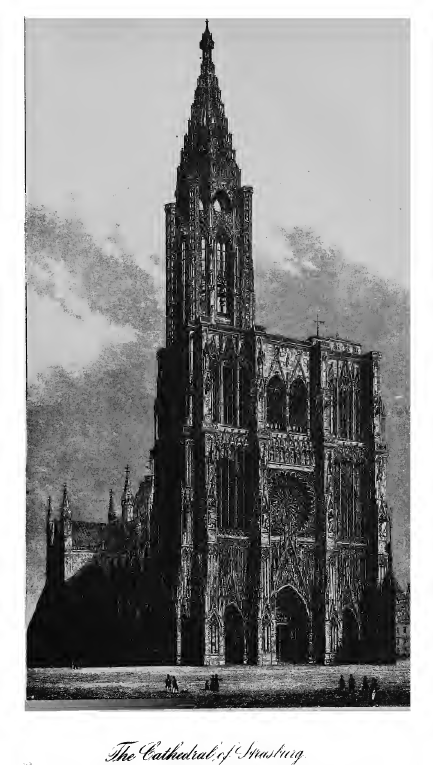
The documented history of Freemasonry begins with the medieval stonemasons who built the castles, abbeys and cathedrals of Europe. Their lodge was at first a working place on the building site. The historian David Stevenson describes it: “Originally a mason’s lodge was, it seems, simply a sheltered working place, a temporary construction on the building site, perhaps a sort of lean-to against the wall of an existing building or of that under construction, or a separate shed, where the masons could shape and carve the stone out of the sun or rain.” In time the word came to mean the masons themselves and the rules they kept.
Those rules were written down in the Old Charges, also called the Gothic Constitutions. The oldest is the Regius Poem, of which Mackey writes: “The earliest of the old Constitutions. It is in poetic form, and was probably transcribed in 1390 from an earlier copy.” The Cooke Manuscript follows around 1450. Together they hand down both the legendary history of the Craft and the duties of the mason to God, to his master and to his fellows. In medieval English the word “freemason” meant a fully skilled mason who could work fine freestone, as opposed to a rough mason.
Scotland and William Schaw
Scotland gave Freemasonry its first lodge system. In Edinburgh the Incorporation of Masons and Wrights received its charter in 1475, and lodges are recorded at Aberdeen in 1483 and Dundee in 1537. On 28 December 1598 William Schaw, Master of Works to King James VI and General Warden of the masons, issued the first Schaw Statutes for all the master masons of the realm, and a second set followed on 28 December 1599. That same year the minutes of the lodges of Edinburgh and Aitchison’s Haven begin, the oldest lodge minutes in the world.
Scottish lodges soon began to admit gentlemen who were not working masons. The first known was John Boswell of Auchinleck, at a meeting of the Lodge of Edinburgh in 1600, and on 20 May 1641 members of the Lodge of Edinburgh serving with the army admitted Sir Robert Moray, later a founder of the Royal Society. Stevenson’s conclusion is that Freemasonry as an organised movement was born “in Scotland around 1600, and that if anyone can be claimed as its founder that man was William Schaw”.
England: Elias Ashmole and the accepted masons
In England the records of the London Masons’ Company, which begin in 1619, mention the “Acception”, an inner circle into which gentlemen as well as working masons were “accepted”. The best-known early English Freemason is the scholar Elias Ashmole, founder of the Ashmolean Museum in Oxford. On 16 October 1646, as his diary records, he “was made a Free Mason at Warrington in Lancashire”, together with Colonel Henry Mainwaring. Stevenson calls this “the first known ‘lodge’ in England (apart from Medieval-type building-site lodges), and the first ‘lodge’ known anywhere with no operative members.” In March 1682 Ashmole attended a lodge at Masons’ Hall in London as its senior fellow.
1717 and the first Grand Lodge
On St. John the Baptist’s Day, 24 June 1717, four London lodges, meeting at the Goose and Gridiron in St. Paul’s Churchyard, the Crown near Drury Lane, the Apple-Tree Tavern in Covent Garden and the Rummer and Grapes in Westminster, formed a Grand Lodge and chose Anthony Sayer as their first Grand Master. In 1723 the Grand Lodge published the Constitutions compiled by Dr. James Anderson, with the Charges of a Free-Mason that still guide the Craft today.
Masonic historians have long debated whether 1717 was a beginning or a revival. Mackey’s Encyclopedia answers that the work of Anderson, of Desaguliers and their contemporaries “was to improve and to enlarge, but not to invent.” The Grand Lodge of Ireland was at work by 1725, and the Grand Lodge of Scotland was formed in 1736.
Antients, Moderns and the Union of 1813
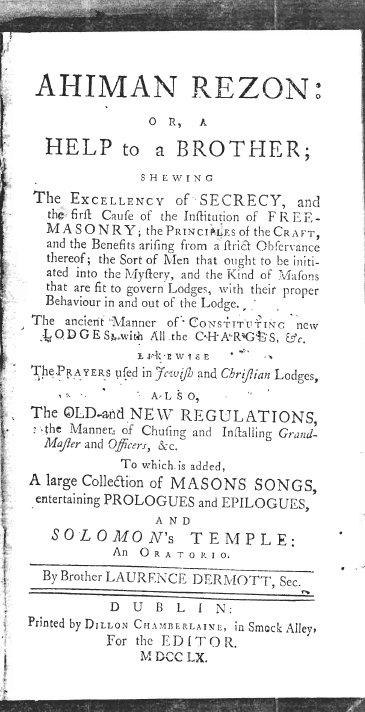
In 1751 a group of Freemasons in London, many of them Irish, formed a rival “Grand Lodge of England according to the Old Institutions”. Its members called themselves the Antients and the older Grand Lodge the Moderns, and their energetic Grand Secretary, Laurence Dermott, published their own book of constitutions, Ahiman Rezon, in 1756. For sixty years England had two Grand Lodges. On 25 November 1813 the Articles of Union were signed by the Duke of Sussex and the Duke of Kent, and on 27 December 1813 the two bodies united as the United Grand Lodge of England.
The two sides were not as far apart as their names suggest. Fred L. Pick and G. Norman Knight, in The Pocket History of Freemasonry, point out that calling the Antients “seceders” is “quite unjustified seeing that not one of the first dissidents belonged to any lodge under the jurisdiction of the premier Grand Lodge”, and that their customs differed scarcely at all from those of their Irish and Scottish brethren. What divided them was the slack administration of the older Grand Lodge and the changes it had made to old custom: between 1730 and 1753, for example, not one of its Grand Masters was installed on the days of St John, the traditional Masonic festivals. The Duke of Atholl ruled the Antients from 1774, and by 1813 two royal brothers stood at the head of the two branches of the English Craft, the Duke of Kent for the Antients and the Duke of Sussex for the Moderns. Their twenty-one Articles of Union declared that “pure Ancient Masonry consists of three degrees and no more”, together with the Royal Arch. A Lodge of Reconciliation (1813 to 1816) brought the two ways of working together, and the Duke of Sussex became the first Grand Master of the United Grand Lodge, with 647 lodges on its roll. In the authors’ words, “Thus also was happily ended the feud of sixty years.”
The Craft spreads around the world
From the British Isles the Craft travelled with merchants, sailors and soldiers. The first lodge in Paris was founded around 1725. In 1728 the Grand Lodge of England warranted lodges for Bengal and for Gibraltar, and in 1730 it appointed a Provincial Grand Master for New York, New Jersey and Pennsylvania. The Irish Grand Lodge invented the travelling warrant for army regiments in 1732, and by 1813 it had warranted 190 regimental lodges, which carried Freemasonry to every corner of the empire. In Philadelphia a young printer named Benjamin Franklin was initiated in 1731 and became Grand Master of Pennsylvania in 1734.
In Boston, on 6 March 1775, Prince Hall and fourteen other free Black men were initiated in a lodge attached to a British regiment. In 1784 the Grand Lodge of England granted them a charter as African Lodge No. 459, the foundation of Prince Hall Freemasonry, which today has Grand Lodges across the United States and beyond. The Craft also met opposition: in 1738 Pope Clement XII issued the bull In Eminenti against it, the first of several papal condemnations.
The higher degrees and the Egyptian rites
The eighteenth century also saw the growth of the higher degrees. The earliest known record of the Royal Arch degree being conferred is in the minutes of Fredericksburg Lodge in Virginia, dated 22 December 1753. The Ancient and Accepted Scottish Rite took its present form when its first Supreme Council was opened at Charleston, South Carolina, in 1801.
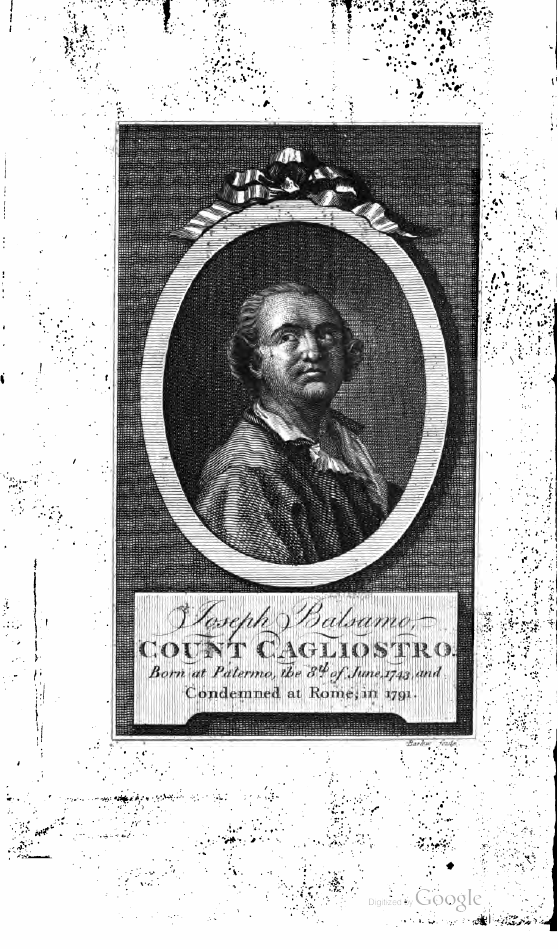
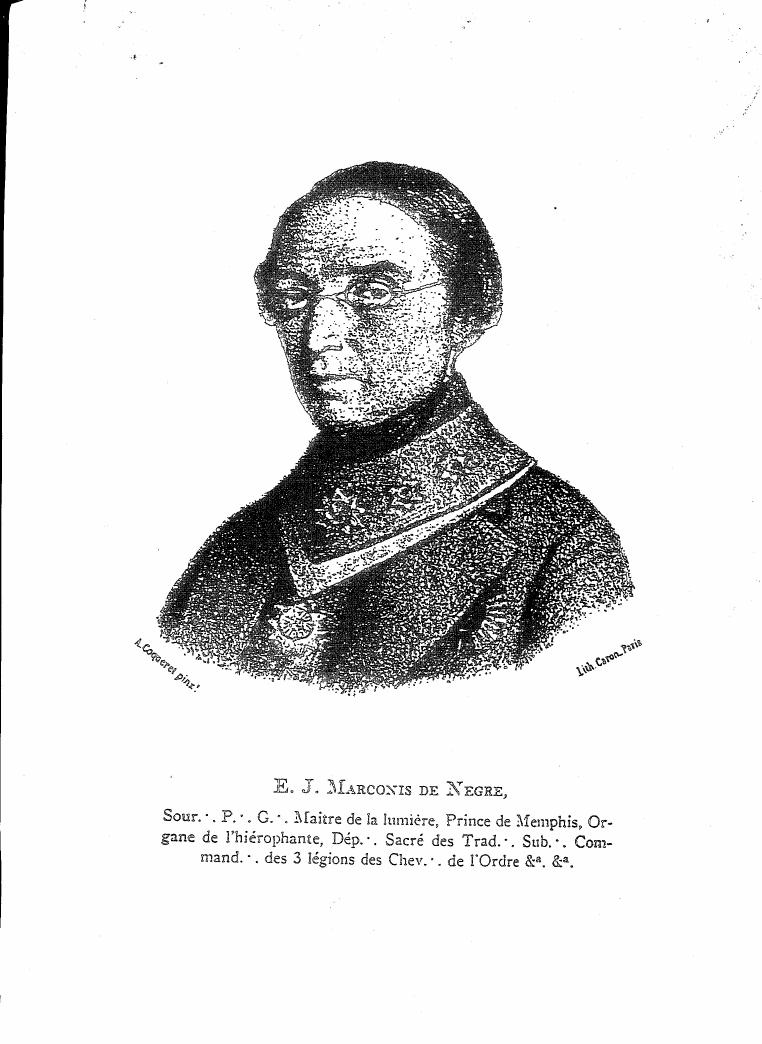
Interest in ancient Egypt gave birth to rites of its own. The famous Count Cagliostro was received into Freemasonry in the Esperance Lodge in London in 1777 and soon founded his own “Egyptian Rite”, which admitted women as well as men; its first lodges appeared from 1779. He claimed that his rite came down from the prophets Enoch and Elijah and the temples of Egypt. His career ended in the hands of the Roman Inquisition, which arrested him in 1789; his sentence of death was commuted to life imprisonment, and he died in the fortress of San Leo in 1795. After him came the Rite of Misraïm, organised in Italy and brought to Paris by the Bédarride brothers in 1814, and the Rite of Memphis, organised by Jacques-Étienne Marconis de Nègre in 1838. The two were joined in 1881 under Giuseppe Garibaldi to form the Ancient and Primitive Rite of Memphis-Misraïm. Milko Bogard, himself a member of an Egyptian rite, sums up its history honestly: “Simply stated; the rite is only “Egyptian” in its name.” Its Egyptian descent is a tradition; its love of the wisdom of Egypt is real.
The Rosicrucian manifestos, the Fama (1614), the Confessio (1615) and the Chymical Wedding (1616), also left their mark on Masonic history, in the Gold- und Rosenkreuz of the eighteenth century and the Societas Rosicruciana in Anglia, founded in 1866 for Master Masons. Christopher McIntosh, historian of the Rosicrucians, writes of the claim that Freemasonry came from them: “We have no proof of this”. In France, Martinez de Pasqually’s Élus Coëns of the 1760s and the Rectified Scottish Rite, adopted at the Convent of Wilhelmsbad in 1782, added another rich chapter to the story.
It was in France that the Rosicrucian current first entered the Masonic degrees themselves. McIntosh records that “a Rose-Croix grade was being operated in France as early as 1754”, and a similar grade, the Rose-Croix of Heredom, became the Eighteenth Degree of the Ancient and Accepted Scottish Rite. In Lyon, Jean-Baptiste Willermoz, a disciple of Martinez de Pasqually, wrote the rituals that the Convent of Wilhelmsbad accepted in 1782, when the brethren of its inner order took the name “Knights Beneficent of the Holy City”; as Robert Ambelain puts it, “the Scottish Rectified Ritual contained for the greater part, the Ritual of Lyon”. Louis-Claude de Saint-Martin (1743 to 1803), the “Unknown Philosopher”, carried Pasqually’s teaching into a mystical Christianity, and a century later Dr. Gérard Encausse, known as Papus, spread the Martinist Order from 1887, with “the creation of a Supreme Council of 21 members” in 1891. In France the Rosicrucian and Martinist traditions have walked beside Freemasonry ever since.
Six thousand years of building
Seen whole, the history of Freemasonry is the history of building, outward and inward. The builders of Sumer laid their first sacred brick to a plan revealed in a dream. The builders of Egypt worked with the square, the plumb and the cubit rod, under the ideal of Maat. Bezalel taught his art in the wilderness, and Solomon’s builders raised the Temple with stones made ready before they were brought to the site. The medieval masons kept their Old Charges, Schaw gave Scotland its lodges, Ashmole was made a Mason at Warrington, and in 1717 four London lodges began the Grand Lodge system that now spans the world.
Nor is it the story of one nation. The old Cooke Manuscript says that from Egypt the craft “went from land to land and from kingdom to kingdom”, and the Craft’s own records bear this out. France gave Freemasonry much of its higher learning: a Council of Emperors of the East and West, organised in Paris in 1758, worked the Rite of Perfection, and in 1761 it granted a patent to Stephen Morin to carry that rite to the Americas, where it grew into the Ancient and Accepted Scottish Rite, alongside the Rosicrucian and Martinist orders of Lyon and Paris. In Italy, Giuseppe Garibaldi, Grand Master at Palermo in 1860, called the Italian Masonic bodies together in 1867 to unite them. In Egypt, the Grand Orient of France founded the lodge La Bienfaisance at Alexandria in 1802; lodges of the Italian, Scottish, German and English constitutions followed, Prince Halim Pasha, son of Mehemet Ali, became Grand Master of the Rite of Memphis there, and in 1879 the National Grand Lodge of Egypt was proclaimed “free, sovereign and independent”. In India, Umdat-ul-Umrah Bahadur, son of the Nawab of Arcot, was initiated in 1776, and the Grand Lodge of England wrote to him that “the good moral Man of every country or denomination is qualified to participate . . . without regard to the mode in which he pays his adoration to the Supreme Architect of the Universe.” In 1843 the Lodge Rising Star of Western India was founded in Bombay with three Muslims and a Parsi among its founders, and Indian brethren celebrated the Craft’s power to bring “the whole human race into one family”. From Sumer, India and Egypt to Jerusalem, France and Italy, builders of many nations have laid their stones in the one Temple.
The organised Craft, with its lodges and records, is some four centuries old. Its tradition, counted from the Year of Light, reaches back six thousand years and more, to the first men who built by plan and measure in honour of the Great Architect. Freemasons hold both stories with pride: the documented history of their lodges, and the much older story of the builders whose work and ideals the Craft has made its own.
Further reading


Sources:
Albert G. Mackey, Encyclopedia of Freemasonry (revised edition): “Anno Lucis”, “Calendars, Masonic”, “Halliwell Manuscript”, “Cooke’s Manuscript”, “Revival”, “Ancient or Atholl Freemasons”, “Union of 1813”, “Ireland”, “Scotland”, “Negro Lodges”, “Scottish Rite”, “Pythagoras”, “Larmenius”, “Egypt”, “Italy”, “Garibaldi, Giuseppe”; An Encyclopedia of Freemasonry and its Kindred Sciences (1st ed.), “Egypt”; History of Freemasonry (1906), vols. I, IV, VI
David Stevenson, The Origins of Freemasonry: Scotland’s Century, 1590–1710 (Cambridge University Press, 1988)
Jessica L. Harland-Jacobs, Builders of Empire: Freemasons and British Imperialism, 1717–1927 (2007)
Fred L. Pick and G. Norman Knight, The Pocket History of Freemasonry
R.W.Bro. Bharat V. Epur, OSM, Demystifying Freemasonry: To the Profane and the Initiate (2021)
Robert Ambelain, Le Martinisme: Histoire et Doctrine (Paris, 1946; tr. Piers A. Vaughan, 2002)
Michael A. Cremo, The Forbidden Archeologist
Praveen Mohan: Kanchi Kailasanathar Temple (video, 30 September 2019); Kailasa Temple, Ellora (video, 18 June 2014); The Secret Treasures of Indian Temples (The Ranveer Show, January 2023)
Manly P. Hall, The Secret Teachings of All Ages (1928); The Lost Keys of Freemasonry (1923)
Joseph Fort Newton, The Builders (1914); Leader Scott, The Cathedral Builders (1899); Frank C. Higgins, Hermetic Masonry / The Beginning of Masonry (1916)
The Cooke Manuscript (c. 1450), with translation; James Anderson, The Constitutions of the Free-Masons (London, 1723), title page via the Grand Lodge of British Columbia and Yukon
Grand Lodge of Pennsylvania, “Shedding Light on Anno Lucis” (2016)
Electronic Text Corpus of Sumerian Literature (Oxford), “The building of Ningirsu’s temple” (Gudea Cylinders A and B)
Leon Legrain, “The Third Dynasty of Ur. The Stela of Ur-Nammu”, University Museum Bulletin X (1944); Penn Museum, Ur-Nammu stele B16676.14
The Metropolitan Museum of Art, foundation figure of Ur-Namma, 47.49; masons squaring a block, tomb of Rekhmire, 31.6.23 (Open Access, CC0)
American Research Center in Egypt, “Explore the Village of Deir el Medina”
Shafik Farid and co-author, KMT (2001), on the tomb of Sennedjem; Grand Egyptian Museum, plumb level of Sennedjem and glossary “Maat”
Manasara (Wisdom Library edition); Pant and Funo (2005), Journal of Asian Architecture and Building Engineering, on Mohenjo-daro bricks; The Metropolitan Museum of Art, essay on the Indus civilisation
Tanakh (JPS 1917) via Sefaria; King James Version via BibleGateway
Biblical Archaeology Society and SBL Bible Odyssey, on the archaeology of Solomon’s Temple and ‘Ain Dara
Catholic Encyclopedia (1912), “Templars”; The Temple Church, London, history
Milko Bogard, Of Memphis and of Misraim (2018); Christopher McIntosh, The Rosy Cross Unveiled; Henry Ridgely Evans and other writers on Cagliostro, as cited in Mackey and Findel