The claim
CLAIM #14:
The Swastika was invented by Nazis and is Masonic in origin?
FALSE
ANSWER:
The swastika is one of the oldest symbols in human history, in use for thousands of years before the Nazis appropriated it. It was not invented by the Nazis, and it has never been a Masonic emblem.

This claim makes two separate assertions: that the Nazis invented the swastika, and that the symbol is Masonic in origin. Both are false, and the historical record on each point is clear. Understanding why matters, because the symbol remains sacred to hundreds of millions of people today, and because its brief association with the Nazi regime has been used to spread a further falsehood about Freemasonry.
The image above shows the swastika in two of its forms, one facing left and one facing right. Both have been in use around the world for millennia. That variety alone tells the story: no single movement, in any century, can claim to have invented a sign that appears in so many shapes and in so many cultures.
One of humanity’s oldest symbols
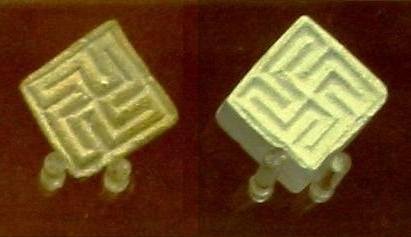
The swastika is found in the archaeological record long before the invention of writing. One of the earliest known examples is a figurine carved from mammoth ivory, found at Mezine in Ukraine and dated to between 10,000 and 17,000 BCE. The motif appears again in the Neolithic Vinča culture of south-eastern Europe, and from around 3000 BCE it is well attested in the Indus Valley Civilisation, where it was carved into seals such as those pictured here.
The name itself comes from Sanskrit. It derives from the root swasti, meaning health, luck, success and prosperity. In Hinduism, Buddhism and Jainism the swastika has been a sacred sign of good fortune and divinity for thousands of years, and it remains so today: in Buddhism it represents the auspicious footprints of the Buddha, and in Jainism it is the symbol of the seventh tirthankara, Suparshvanatha. It can still be seen on temples and homes across Asia. Even Germany, which bans the public display of Nazi symbols, exempts swastikas on Hindu, Buddhist and Jain temples.
Across the ancient world
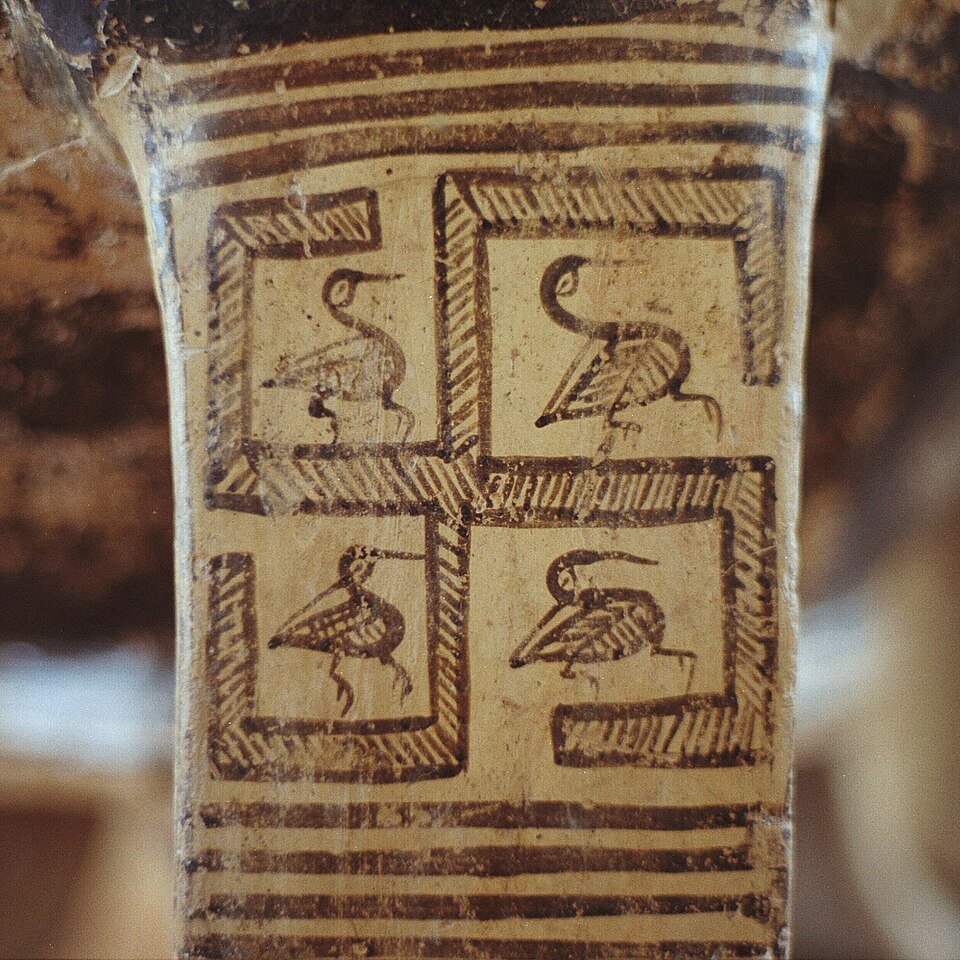
The symbol was by no means confined to Asia. It decorated the pottery of ancient Greece, appeared among the Celts and in Norse tradition, and was used by Indigenous peoples of the Americas. Among the Pima people of Arizona, for example, it represents the four winds. When the archaeologist Heinrich Schliemann excavated the site of ancient Troy, he recorded more than 1,800 instances of the swastika and its variants.
Masonic scholars documented this long before the Nazi Party existed. Writing in 1914, the American Freemason Joseph Fort Newton described it as follows:
“the mysterious Swastika is perhaps the oldest, as it is certainly the most widely distributed over the earth. As much a talisman as a symbol, it has been found on Chaldean bricks, among the ruins of the city of Troy, in Egypt, on vases of ancient Cyprus, on Hittite remains and the pottery of the Etruscans, in the cave temples of India, on Roman altars and Runic monuments in Britain, in Thibet, China, and Korea, in Mexico, Peru, and among the prehistoric burial-grounds of North America.”
Joseph Fort Newton, The Builders: A Story and Study of Masonry (1914)
A good-luck charm in the modern West

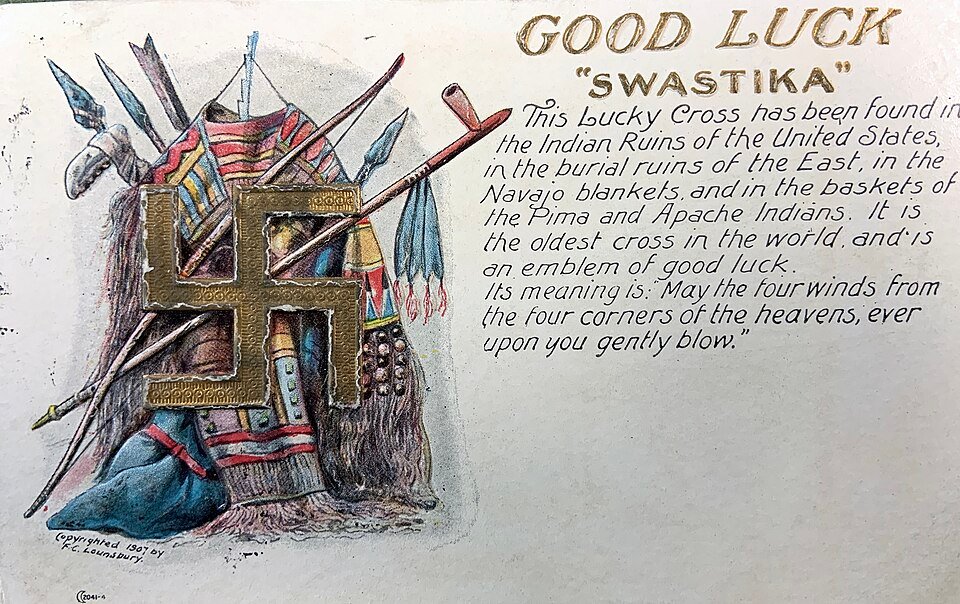
In the early twentieth century the swastika enjoyed a wave of popularity in Europe and North America, where it was understood almost universally as a sign of good luck. Rudyard Kipling used it on the covers of several of his books, including The Five Nations (1903). It appeared on postcards, jewellery and household goods; in 1912 The Ladies’ Home Journal offered its readers a swastika pillow cover. A Canadian women’s ice hockey team, pictured here, played under the name the Fernie Swastikas.
Armed forces adopted it too. The Latvian Air Force adopted it in 1918–19, and the Finnish Air Force carried a blue swastika on its aircraft until 1945. In the United States, the Army’s 45th Infantry Division wore a yellow swastika on a red diamond as its shoulder insignia, a design it abandoned only in 1939, when the symbol’s new associations had become impossible to ignore. None of these organisations had any connection with Nazism. They simply used a familiar and well-loved emblem.

How the Nazis came to use it
The Nazis did not invent the swastika; they appropriated it. The path ran through nineteenth-century scholarship. After Schliemann’s discoveries at Troy, the French scholar Émile Burnouf wrote to him in 1872 that “the Swastika should be regarded as a sign of the Aryan race”. Schliemann accepted the idea, and the theory that the swastika was the emblem of an ancient “Aryan” people spread through European nationalist circles.
In Germany, the völkisch nationalist movement had already adopted the symbol before the Nazi Party existed. The Nazi Party formally took it up in 1920. In Mein Kampf (1925), Hitler described the party flag he had chosen: a red background, a white disc and a black swastika. On 15 September 1935 that flag became the sole national flag of Germany. In other words, the Nazis took one form of an ancient and widely loved symbol and attached to it a meaning it had never carried before. A mid-twentieth-century edition of Mackey’s Encyclopedia of Freemasonry observes that the swastika was being “discarded and forgotten (except for trade-marks) until the Nazis, for some obscure reason of their own, adopted one of its thousand forms for their emblem.”
Is the swastika Masonic?
No. The swastika is not a Masonic symbol and does not originate in Freemasonry. The principal symbols of the Craft are the square and compasses, working tools such as the level and the plumb rule, and the letter G, none of which bears any resemblance to it. The same edition of Mackey’s Encyclopedia addresses the question directly:
“It has never had a place in Freemasonry, except in the Scottish Prince of Mercy Degree, and then in a scarcely recognizable form, and with a special meaning defined by the Degree.”
Mackey’s Encyclopedia of Freemasonry, revised edition
Where the swastika does appear in Masonic literature, it is as an object of study, in the same way that historians and archaeologists studied it. One of the most thorough studies of the symbol, The Migration of Symbols (1894), was written by Count Goblet d’Alviella, a Belgian senator and a prominent Freemason, who concluded that its beginnings could not be traced. In 1911–12 the Masonic researcher Thomas Carr reported that a small society of “Operative” Masons in England used it as a symbol of the Supreme Architect of the Universe, much as many other groups of that era used it as a sign of good fortune. All of this predates the Nazi movement, and none of it suggests that Freemasonry created the symbol or gave it to anyone.
It is worth remembering, too, which side Freemasons were on. As explained in Claim #13, the Nazi regime banned Freemasons from its party, closed every lodge in Germany and persecuted their members. To suggest that the Nazis’ emblem was a Masonic gift is to misunderstand both the symbol and the history.
Conclusion: The swastika is a symbol of great antiquity, found from Ice Age Ukraine to the Indus Valley, from ancient Greece to the Americas, and still sacred in Hinduism, Buddhism and Jainism. In the early twentieth century it was a common Western emblem of good luck. The Nazis appropriated one form of it in 1920 and gave it the associations it carries in the West today. It was not invented by the Nazis, and it is not, and never has been, a Masonic symbol.
Sources:
https://en.wikipedia.org/wiki/Swastika
https://www.gutenberg.org/ebooks/40812 (Thomas Wilson, The Swastika, the Earliest Known Symbol, and Its Migration, U.S. National Museum, 1894)
https://www.gutenberg.org/ebooks/19049 (Joseph Fort Newton, The Builders, 1914)
Mackey’s Encyclopedia of Freemasonry, revised edition, entry “Swastika, The”