The claim
CLAIM #2:
The 5 Point Pentagram symbol used in Freemasonry, is Satanic?
FALSE
ANSWER:
The pentagram is thousands of years older than Satanism, and in Freemasonry it has never stood for anything devilish. The goat-in-a-star “satanic” version was only drawn in 1897, by a French occultist.

To understand this one, we first need to know what a pentagram actually is, where it was first used, and when other people started borrowing it for their own purposes. Spoiler: it has had a very long and very busy career.
A little history
Source: Encyclopedia Britannica:
The pentagram, a five-pointed star typically drawn using one continuous line of five straight segments, has been used throughout history as a symbol, often in the realm of magic or the occult. Its meaning has evolved and varied greatly over time: it has served as a symbol of protection, perfection, the Devil and humanity, among others. Mathematically, the segments of the pentagram exhibit the Golden Ratio, which may contribute to its aesthetic appeal.
The pentagram has been in use for thousands of years, appearing in ancient tombs and seals in Egypt and Mesopotamia, as well as on coins in Greece. It was a symbol of the Greek mathematician and philosopher Pythagoras and his followers, and may have been a way for them to recognise each other. Some sources suggest that the Pythagoreans viewed it as a symbol of health and knowledge, and in some depictions the Greek letters for the word “health” are placed at its points. It may also have been used to ward off evil in ancient Greece and other cultures. It has even been found on pottery from the ancient kingdom of Judaea, possibly as a mark of tax collectors.
In medieval Europe, the pentagram was a symbol of the five knightly virtues. In the poem Sir Gawain and the Green Knight, Sir Gawain wears a golden pentagram on both his shawl and his shield as a mark of his virtue, loyalty and kindness. Pentagrams were also used as a defence against witches, evil spirits and demons — the very opposite of what the claim suggests.
In the 16th century, Heinrich Cornelius Agrippa von Nettesheim published a version of the pentagram that symbolised man as a perfected work of God, with the head, hands and feet as the five points, surrounded by symbols of the five known planets. The French occultist Éliphas Lévi expanded on this idea in the 19th century with the “Tetragrammaton pentagram,” which incorporates various symbols representing human existence, including planetary and astrological symbols, symbols of the four elements, and Hebrew letters.
The pentagram was also used by Freemasons, who sometimes placed a “G” in the centre to represent Gnosis, generation and the Grand Architect. A late-19th-century history of the Freemasons notes the variety of uses for the pentagram, such as a symbol of man, a demon, protection, magic and others.
In religious contexts, the pentagram has taken on different meanings. Among Muslims, it is known as Solomon’s seal and is thought to represent love, truth, peace, freedom and justice. It is also the official symbol of the Bahāʾī Faith, where it is sometimes called the haykal, which means “temple” or “body” in Arabic. Among Christians, it has symbolised the five wounds of Christ, the Star of Bethlehem, and Christ himself.
In modern times, the pentagram is most often associated with Neo-Pagan religions, especially Wicca. When drawn inside a circle, it is known as a pentacle. In these traditions, the five points often represent the five elements of air, fire, water, earth and spirit. For Wiccans, the pentagram may also symbolise masculine and feminine, or the Triple Goddess (three points) and the Horned God (two points). Many Neo-Pagans consider it a symbol of protection and may use it to invoke or banish spirits. The pentacle is the approved symbol of the Wiccan faith for use on headstones in U.S. government cemeteries.
The inverted pentagram, with two points facing upward and one facing down, is sometimes associated with negative or “black” magic and devil worship. The inverted pentagram features in the sigil of Baphomet, a symbol of the Church of Satan — an atheist organisation that evokes the devil as viewed in Christianity but does not worship any gods or beings, and does not require its members to perform any rituals, magical or otherwise. The sigil of Baphomet shows a goat with its horns in the upturned points of the star. This likely stems from the 19th-century European revival of occult studies, when it was believed that a pentagram with one point upward symbolised ascendance, God and supremacy of the spirit, while one with a point downward symbolised Satan, infernalism (everlasting torment) and descent of the spirit. This is probably why, in Wicca, the pentagram is most often drawn with one point facing upward.
Source/Credit: Alison Eldridge
https://www.britannica.com/topic/pentagram
The finer details
Pentagram: from the Greek “Pente”, meaning five, and “Gramma”, a letter. The pentagram is a five-pointed figure formed by extending the sides of a pentagon both ways until they meet, so as to form a five-pointed star.
Pentalpha: the triple triangle, from the Greek words meaning five and alpha, the letter A. The pentagram (also called pentacle, pentalpha or pentangle) is thought by some occultists to trace its esoteric significance to an astronomical observation of the pattern of Venus’ conjunctions with the Sun, and it has had many meanings in many cultures through the ages. Although people commonly call any five-pointed star a pentagram, a distinction can be made.
The outline of the pentagram, or “endless knot”, is a five-pointed star, but a five-pointed star does not necessarily represent the pentagram. Religious fundamentalists rarely make any distinction, while some occultists and modern Wiccans make even finer ones and define the pentacle as a pentagram inside a pentagon or circle. Historically, the pentacle referred to any amulet, often incorporating a hexagram. “The words pentagram and pentacle (or pentacle) are not necessarily connected with the number 5. Pentacle probably comes from an old French word ‘to hang’ and means a talisman or, by extension, any symbol used in magical operations.” There is little agreement on these distinctions.
European heraldry deserves its own note. There, stars are generally called estoiles or mullets. Estoiles, at least in England, have six wavy rays. Unless described otherwise, a star with straight rays is termed a mullet and has five points. It should also be pierced since, properly speaking, it does not represent a star at all but the rowel of a spur. It has no connection with celestial stars or with the pentagram.
De Vogel, Goff and Van Buren tell us that the use of the pentagram dates back to Uruk IV (c.3500BCE) in ancient Mesopotamia, where the general sense seems to be “heavenly body.” By the cuneiform period (post-2600 BCE) the pentagram or symbol UB means “region”, “heavenly quarter” or “direction”. “That this symbol always has a specific unambiguous meaning continues to be an unsupported hypothesis.” It is found on potsherds at Uruk (near the mouth of the Gulf), and more frequently on Jemdet Nasr (3100-2900 BCE) and Proto-Elamite tablets (3000-2500 BCE). Examples elsewhere are infrequent.
Historically, it does not appear to have been equated with Venus. Venus is equated with the Sumerian goddess Ishtar (Ishihara, Irini, Inanna), whose symbol is an eight- or sixteen-pointed star. Among the Hebrews, the five-pointed symbol was ascribed to Truth and to the five books of the Pentateuch. In Ancient Greece it was called the Pentalpha, and the Pythagoreans considered it an emblem of perfection, or the symbol of the human being. The pentagram was also associated with the Golden Ratio ~ Fibonacci (which it contains), and with the Dodecahedron, the fifth Platonic solid, which has twelve pentagonal faces and was considered by Plato a symbol of the heavens. Burkert says that the pentagram had a secret significance and power for the Pythagoreans, and was used as a password or sign of recognition among themselves.
So is the pentagram satanic in origin?
In a word: no.
As you’ve just seen, the pentagram is not only an ancient symbol, it has also represented the Tetragrammaton, among many other things. It is true, though, that occult circles have long held a rule of thumb: a pentagram with one point up stands for the positive principle, and one with two points up stands for the negative.
That rule comes from one man: Éliphas Lévi. He claimed that the direction of the points decides whether the pentagram represents good or evil — one point up meaning order and light, two points up meaning disorder and darkness. Lévi gave no justification or citation for this distinction; he simply declared it, and then went on to equate the pentagram with the Baphomet, or goat-headed god. In doing so he ignored (or bent) the pentagram’s appearance, one point down, on a seal attributed to Emperor Constantine, its later medieval use as a medical symbol of health, and its Christian use as a symbol of the Transfiguration of Christ.


The goat-in-a-star design shown on the right —> is the sigil of the Church of Satan, which Anton LaVey founded in 1966; the Church used it from its early years, and the complete graphic first appeared in public in 1968. LaVey copyrighted the symbol in 1968, and it was trademarked with the words “Church of Satan” in 1983. Before the 19th-century occultists below, the symbol was never used to represent Satan or evil at all — and it certainly doesn’t appear in the Bible or the Torah.
The roots of this logo are in the writings of Éliphas Lévi — his Dogme et Rituel de la Haute Magie (1854–56, reissued 1861), translated into English by A.E. Waite as Transcendental Magic — and in a later book, La Clef de la Magie Noire (1897), by the French nobleman and occultist Stanislas de Guaita. It was Guaita’s book that first printed a goat’s head inside an inverted pentagram. Both men’s imagery has the same fingerprints and the same origin: their own imaginations. Before these dates, no such logo or symbol existed, whatever the people sharing this claim may say.
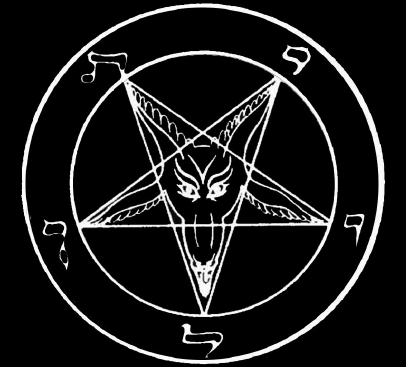
The logo is made of two symbols: the “inverted” five-pointed pentagram and the goat’s head of the Sabbath. And here’s a detail worth remembering: the star in this logo does not point the same way as the one on the forehead of Lévi’s Baphomet. More on that below.
So the “good and evil” rule for the pentagram comes from Éliphas Lévi — not from religion, and not from fact, but from his imagination. It was Anton LaVey who turned it into a satanic emblem in 1966, building on the images of Lévi and Stanislas de Guaita, before trademarking the “Goat’s head within an inverted 5-point pentagram with the words “Church of Satan” in 1983. Before Lévi in the 1850s, this goat-head-in-an-inverted-star symbol did not exist anywhere. Not once.

Who was Emperor Constantine?
Constantine I, known as Constantine the Great officially Flavius Valerius Constantinus, (born Feb. 27, after 280? CE, Naissus, Moesia—died May 22, 337, Ancyrona, near Nicomedia, Bithynia), First Roman emperor to profess Christianity.
The eldest son of Constantius I Chlorus, he spent his youth at the court of Diocletian. Passed over as successor to the throne, he fought to make himself emperor. Victory at the Milvian Bridge outside Rome (312) made him emperor in the West. According to legend, a cross and the words in hoc signo vinces (“In this sign, conquer”) appeared to him there, and he forthwith adopted Christianity. In 313 he issued, with Licinius, the Edict of Milan, granting tolerance to Christians; he also gave land to churches and granted the church special privileges. He opposed heresies, notably Donatism and Arianism, and he convoked the Council of Nicaea. After defeating and executing Licinius, he gained control of the East and became the sole emperor. He moved the capital from Rome to Byzantium, which he renamed Constantinople (324). In 326 he had his wife and eldest son killed for reasons that remain obscure. He angered the Romans by refusing to participate in a pagan rite and never entered Rome again. Under his patronage, Christianity began its growth into a world religion. Constantine is revered as a saint in the Orthodox church.
Source/Credit:
https://www.britannica.com/summary/Constantine-I-Roman-emperor
But what about Baphomet?
People who spread the “inverted pentagram equals Baphomet” idea tend to skip over some important details — and frightening stories travel faster than careful ones. History has plenty of examples of where that leads: in past centuries, innocent people were accused of heresy and even burned at the stake because a crowd had made up its mind. Fear and misinformation are poor substitutes for critical thinking.
A famous example is the story of Giordano Bruno — see here for more details.
In the previous section #1, we looked at the facts about Baphomet, which many people now link to Freemasonry thanks to Léo Taxil’s hoax. But take a closer look at the picture of Baphomet and you’ll notice something that most versions of this claim have missed…

As we saw above, Éliphas Lévi — the occultist who started all this — claimed that the direction of the pentagram’s points decides whether it represents good or evil. According to Lévi, one point upward represents order and light, while two points upward (the “inverted” pentagram) represents disorder and darkness.
His claim that the pentagram is a symbol of Baphomet, the goat-headed god, is arbitrary and comes with no justification or citation. And now look at Baphomet’s forehead: the pentagram there is upright, one point up — which, by Lévi’s own rule, means order and light. Lévi’s picture contradicts Lévi’s rule.
Anyone can claim that Baphomet represents evil, but it makes no sense to flip the pentagram on Baphomet’s head upside down and then call it evil, when the original is the right way up. If anything, Lévi’s drawing raises questions about whether good and evil are meant to be separate or two sides of one coin. Either way, the “inverted star” story only works if nobody looks closely at the picture. Careful study beats fear every time.
What about the Star of Remphan?
Another version of the claim says that the five-pointed pentagram used in Freemasonry and the Star of David are both the so-called “Star of Remphan.” There is no evidence for this at all. It’s also, frankly, an odd argument for a Christian to make, because it ends up trying to distance Christianity from its own Jewish roots.
The idea that the Masonic pentagram and the Star of David are the “Star of Remphan” comes from not knowing the background. The first five books of the Christian Bible, known as the Pentateuch, are the same books as the Jewish Torah. They are:

The Torah:
• בְּרֵאשִׁית Be-reshit ~ Genesis
• שְׁמוֹת Shemot ~ Exodus
• וַיִּקְרָא VaYikra ~ Leviticus
• בְּמִדְבַּר BaMidbar ~ Numbers
• דְּבָרִים Devarim ~ Deuteronomy
The first five books of the Christian Bible.

It is important to understand that the Pentateuch, meaning “five books,” is the first five books of the Christian Bible, which are also known as the Torah, meaning “The Law.” While the terms “Bible” and “Old Testament” are commonly used by non-Jews to describe Judaism’s scriptures, the appropriate term is “Tanakh,” which is an acronym derived from the Hebrew letters of its three components: Torah, Nevi’im, and Ketuvim. The Tanakh includes many more books and writings than the Pentateuch. The Hebrew Tanakh books include:
Neviim – The Prophets
• Yehoshua-Joshua
• Shoftim – Judges
• Shmuel A – 1Samuel
• Shmuel B – 2Samuel
• Melachim A – 1Kings
• Melachim B – 2Kings
• Yisheyah – Isaiah
• Yermiyah – Jeremiah
• Yechezchial – Ezekiel
Treisar – Minor Prophets
• Hoshea – Hosea
• Yoel – Joel
• Amos – Amos
• Ovadiyah – Obadiah
• Yonah – Jonah
• Michah – Micah
• Nachum – Nahum
• Chabakuk – Habakkuk
• Tzefaniyah – Zephaniah
• Chaggi – Haggai
• Zechariyah – Zecharaiah
• Malachi – Malachi
Ketuvim – Writings
• Tehilim – Psalms
• Mishlei – Proverbs
• Eyov – Job
Megilot
• Shir HaShirim –
Song of Songs
• Ruth – Ruth
• Eichah – Lamentations
• Keholet – Ecclesiastes
Ketuvim – Writings
Megilot
• Esther – Esther
• Daniyel – Daniel
• Ezra – Ezra
• Nechemiyah – Nehemiah
• Divrei Yamim A – 1Chronicles
• Divrei Yamim B – 2Chronicles
Sources:
Mainstream Jewish Virtual Library:
https://www.jewishvirtuallibrary.org/the-tanakh-full-text
Jewish Publication Society Bible:
http://www.breslov.com/bible/
So: the core of Christianity is rooted in Judaism, both in its scripture — the Old Testament of the Christian Bible is the Tanakh — and in some of its symbols, such as the Star of David. With that established, we can move on to the “Star of Remphan” itself. People who share this claim say that the Star of Remphan, also known as the “Star of Solomon,” refers to the “god of Saturn” and that it was brought to the Jewish people as a result of the supposed “promiscuity of Solomon,” who had 700 wives and 300 concubines and turned away from God by worshipping idols. This idea is drawn from 1 Kings 11 — see Kings 11:7-8.
These claims have real problems and no evidence behind them. Judaism and Christianity are both Abrahamic religions, and examining every point properly would take a great deal of discussion. To keep things short and clear, we’ll tread carefully, discuss only facts supported by the original Ancient Hebrew texts, and show due respect to the authors of those texts.
There’s an extra wrinkle: the Ancient Hebrew language — not modern Hebrew, but the ancient form in use when the original texts were written — had no word for ‘God’ in the modern sense, and lacked several other words too. Modern Hebrew is different. So, out of respect for the original authors of the Ancient Hebrew texts, we’ll leave certain words untranslated, to get closer to the message they were actually giving. This is a sensitive subject for both Christians and Jews, and unless you study Ancient Hebrew yourself, or someone shows you, you’d never know it. The evidence and sources come from Jewish authors, academics and theologians, and are set out in books such as these:


Response (A)
Here’s the first problem: scripture never describes what the “Star of Remphan” looks like. Those who spread the claim say it has six points — two overlaid triangles, with specific mathematical properties (see Response C below) — and then draw a five-pointed pentagram next to the six-pointed Star of David as if they were the same thing. But even by their own description, the star of Remphan is not a five-pointed pentagram. That one point alone sinks the claim before we’ve even started.
Response (B)
Here’s something people who share this claim often don’t realise: the Tetragrammaton (sometimes written YHWH), ‘the ineffable name of God’ (See 6th Degree Scottish Rite Regalia), is also represented in symbol form by a five-pointed pentagram — and by another symbol, properly called the 64 Base Tetrahedron. The word “Tetragrammaton” appears in many Christian Bibles, a couple of pages before the book of Genesis. Take a look at the images below: both orientations of the star are shown, along with a scan of that page from a Christian Bible. So if we followed this claim’s logic, both symbols would mean God is also Satan, or Moloch. Of course not. That’s the trouble with reading symbols through fear instead of logic: you end up accusing God of being the devil.


Response (C)
The claim goes like this: the Star of Remphan (whose design, remember, is never described in scripture) looks like both the six-pointed Star of David and the five-pointed pentagram, and it is a symbol of the Anti-Christ. Its “mathematics” is said to be two overlaid equilateral triangles. An equilateral triangle’s three angles add up to 180, so each is 60. Which, if you’re counting, already proves it is not a five-pointed pentagram.

The claim states: “two triangles that are 180 each would give us 360 (180 + 180 = 360). When you omit the 0 in 360, you have 36, which some people think means 3 6’s, i.e., 666 – the mark of the anti-christ or the ‘beast”.
There are a few problems with this arithmetic (dropping zeros is a creative way to do maths). But the biggest problem is simpler: the same design existed before Christianity, and was quite common in ancient Sumeria and Mesopotamia.
The claim also leans on the shape in the middle of the Star of David: a hexagon. And because “hex” sounds like witchcraft, the story goes on to talk about ‘witches cursing or hexing an individual’. (This is where the argument really starts clutching at straws.) It is a word coincidence, nothing more — but it has spread surprisingly far.
The same mathematical principles appear in designs from cultures all over the world — ancient Sumeria and Mesopotamia, ancient Egypt, and even Mesoamerica.
The shape and its mathematical properties go back thousands of years. The meaning of the Star of David, however, is rooted in the Kabbalah.
The Zohar 3:73a (the classic text of the Kabbalah, traditionally attributed to the 2nd-century Mishnaic sage Rabbi Shimon bar Yochai, though most historians date its composition to 13th-century Spain) states, “There are three knots connecting [three entities] one to another: the Holy One, blessed be He; Torah; and Israel.” The Jewish soul connects to its Creator through the study and observance of the Torah. The triangle represents the connection between these three entities.

These three entities are each comprised of a pnimiyut (inner dimension) and a chitzoniyut (external dimension). The Torah is comprised of both exoteric teachings (the Talmud, Jewish law, etc.) as well as esoteric teachings (the Kabbalah). God’s “revealed” energy permeates and provides existence to all worlds, but His essence is completely hidden, transcending all of creation. Similarly, the soul (which is a reflection of God) has a revealed element, that level that expresses itself within and vivifies the body, as well as an essence that transcends the body.
The double triangle of the Star of David (Magen David) symbolizes the connection of both dimensions of God, Torah, and Israel: the external level of the soul connects to the external expression of God via studying the exoteric parts of Torah; the essence of the soul connects with God’s essence through the study and application of the teachings of Kabbalah.
The seven fields of the Star of David
Kabbalah teaches that God created the world with seven spiritual building blocks—His seven “emotional” attributes. Accordingly, the entire creation is a reflection of these seven foundational attributes.
They are:
chesed (kindness), Gevurah (severity), Tiferet (harmony), Netzach (perseverance), Hod (splendor),
Yesod (foundation) and Malchut (royalty).
These attributes are divided into three columns: right, center, and left:
| Tiferet (Harmony) | ||
| Gevurah (Severity) | Chesed (Kindness) | |
| Yesod (Foundation) | ||
| Hod (Splendour) | Netzach (Perseverance) | |
| Malchut (Royalty) |

Correspondingly, the Star of David contains seven compartments—six peaks protruding from a center.
• The upper right wing is Chesed.
• The upper left wing is Gevurah.
• The upper center peak is Tiferet. Kabbalah teaches that Tiferet finds its source in Keter, “the Crown,” which is infinitely higher than all the divine attributes which are involved in the “mundane” pursuit of creating worlds.
• The lower right wing is Netzach.
• The lower left wing is Hod.
• The center is Yesod. Yesod is the “Foundation,” and as such, all the other attributes are rooted in, and rise from, this attribute.
• The star’s bottom that descends from its belly is Malchut—the attribute that absorbs the energies of the higher six attributes and uses them to actually descend and create everything—and to “reign” over them.
Put simply, the Star of David is the two-dimensional representation of the Tetragrammaton, the three-dimensional 64 Base Tetrahedron.


Response (D)
There’s also the idea that the Star of David comes from the ‘Shield of David’ (the Magen David, in Hebrew), which in Jewish liturgy signifies ‘God as the Protector (shield) of David’. Kabbalists also popularised the five-pointed pentagram (the Seal of Solomon) as a “Protection against evil spirits”. The version of the story being shared online, however, says this:
“Stephen, at the time of his death – before he was martyred, mentioned Remphan as the subject of idolatrous worship. In the new testament (Acts 7: 43 – 54), he condemned the idolatry behavior that the Jews had taken upon themselves. Even though there are wide variations of the name – such as Molech/Moloch, they all refer to the same God.”
“Stephen had been taken to answer the charges leveled against him before the Sanhedrin – he was caught teaching people what God had said about the temple being destroyed, and how the laws of Moses had changed. He was going through how the children of Israel had sinned and backslid from the original promises given to Abraham (Acts 7: 2 – 8), and adding to their transgressing of the law; they had become idolaters.”
“Going on, he referred to their idols – the star of Remphan inclusive as what they carry around in small ceremonial boxes – in the shapes of tabernacles, and they carry it everywhere, be it on a journey, to a waterfront, everywhere. This mostly intended it to be a form or type of idolatry (Exodus 20:4).”
“Due to their worship of these idols – Star of Remphan and co, Stephen called all of them stiff-necked, as it was a sign of refusal to bow before God due to their pride, uncircumcised, and he went greatly against all they believed, which angered them furiously in return. Later on, their years of frolicking with idols while turning away from God caught up with them as God destroyed their temple just as Jesus and Stephen foretold.”
This narrative tries to link the Star of David to the idolatrous worship of Remphan, and claims that the Jews had strayed from the original teachings of Abraham. But these New Testament verses are routinely taken out of context and misread. The accusations of idolatry, and the references to King Solomon’s many wives and concubines, simply don’t apply to the Star of David today. The Star of David — also known as the Shield of David, or Magen David — is a symbol with a rich history in Jewish tradition and culture, and it should not be confused with idol worship or any of these other accusations.
If Solomon’s wives are the problem, here’s a gentle question for anyone sharing this claim: what about Moses? The Bible gives him Zipporah and, later, “a Cushite woman” (Numbers 12:1) — whether that was a second wife or Zipporah under another description is still debated. And Solomon is far from the only figure in scripture with more than one wife. See Deuteronomy 25:5 – 12 and 2 Samuel: 12 – 8 and 2 Chronicles 11 – 21 and 2 Chronicles 13 – 21 and Exodus 21:10 and Genesis 4:19 and Judges 8:30 and 1 Samuel 1:1-2 and Deuteronomy 21:15 – 17.
This subject could fill several hundred pages, which is beyond the scope of this website, so we’ll keep to a summary based on facts and historical evidence, and draw one conclusion: if one person’s religion allows something that another’s does not, it isn’t our place to judge either religion. This matters a great deal in Freemasonry — it is one of its fundamental principles. A true Freemason does not judge another man’s religion; we accept all brothers, whatever their faith. What we do oppose is ignorance and intolerance, and the right tools for that are knowledge and information. That is the whole reason this website exists, and it is part of what Freemasonry means by a ‘Progressive Science’. See the 30th Degree oath under the Scottish Rite here.
So the idea that the Star of David and the mysterious Seal of Solomon are somehow both satanic doesn’t come from scripture or history. It comes from judging other people’s symbols without looking at the evidence. And it doesn’t hold up.
Webmaster’s Comment: Sadly, claims like this one often go hand in hand with hostility towards anyone who believes differently. Online, that can mean harassment, bullying and even threats against people of other religions, other denominations, or none at all — and it can slide into antisemitism, Islamophobia and other prejudice against non-Christian faiths and groups.
That behaviour runs directly against the heart of Christianity, which teaches love, compassion and acceptance of all people, whatever their beliefs or background. And it’s worth saying clearly: the people who behave this way are a small minority, and they do not represent the views or actions of Christians as a whole.
Here’s a simple test anyone can try. Ask the person sharing the claim to read the following passages, and then ask whether they think these should be applied literally today: 2 Chronicles 15:13 or Deuteronomy 13:13-19 or Deuteronomy 22:21 or Deuteronomy 13:7-12 or Deuteronomy 17:2-5 or Romans 1:24-32 or Exodus 31:12-15 or even Isaiah 14:21 or Ezekiel 9:5-7 or Isaiah 13:15-18. Most Christians will say no, and rightly so. Anyone who answers ‘yes, I condone these’ has shown you that the problem is not the pentagram.

Webmaster’s Comment: Bees build their honeycomb out of hundreds of thousands of hexagons. So if the hexagon is somehow ‘satanic’, as this claim suggests, does that make bees evil? Are bees the spawn of Satan?
Clearly not — yet that is exactly where this logic leads. Leave the bees alone.
Response (E)
Another thing worth knowing: modern scholars have shown that some of the classic translations from Hebrew into Greek and English are open to serious question. For example, the name ‘Yahweh‘ does not mean ‘Lord’ or ‘God’, as it was traditionally rendered from the Original Ancient Hebrew Text. It is a personal name with no translation, so the word ‘Yahweh‘ shouldn’t be translated just for the sake of it, or to fit a religious narrative. The Vatican — the head of the Catholic Church — took the opposite line in a 2008 announcement directing that ‘Yahweh’ or ‘YHWH’ should not be used in the liturgy. The difficulty is that the name Yahweh clearly appears in the original Ancient Hebrew texts (Tanakh/Torah), so the directive sits awkwardly with the original writings.
And for anyone who says Catholicism isn’t a form of Christianity, or is somehow secretive: compare the Bible with the Catholic Bible. You’ll quickly find they are largely identical and come from the same source, with the Bible as the primary source of Christian teaching.
The same goes for the word ‘Elohim’. It is grammatically plural; when it refers to the God of Israel it is usually treated as singular, but elsewhere in the Hebrew Bible it plainly means ‘gods’ or a group of divine beings — so simply writing ‘God’ every time hides part of the picture. As for the idea that Elohim means or refers to the ‘holy trinity’: it does not. Its exact sense in the Ancient Hebrew texts is still debated. So, out of respect for the original authors of the Ancient Hebrew texts, our view is that it is better to keep the original word as it was written than to force a translation onto it.
Many scholars believe that the religion of ancient Israel, from which the Old Testament grew, was originally polytheistic, and that it was shaped alongside older texts of the region such as the Enuma Elish, the Epic of Gilgamesh and the Egyptian Book of the Dead. Some authors go further — for example, arguing that the New Testament borrowed from the Roman mystery religion of Mithraism and from the Greek poet Homer (Omero) — though mainstream historians reject those particular claims. See ‘The Naked Bible‘ for that argument in detail. What is widely accepted is that King Josiah of Judah, who came to the throne as a boy of eight in the 7th century BCE, carried out major religious reforms that removed official worship of gods (plural) other than Yahweh. Most biblical scholars credit Josiah with establishing or compiling important Hebrew scriptures during this ‘Deuteronomic reform’. Monotheism then became the foundation that Judaism — and, centuries later, Christianity — was built on, a development Bro. Albert Pike discussed at length in his books, including ‘Morals and Dogma’ (itself the target of plenty of conspiracy theories, some covered in this debunk section). That subject belongs in another part of this website.
Because this topic is delicate and nuanced, and religious doctrine is outside the scope of this website, I’ve chosen to point you to some resources instead. For a deeper understanding, I recommend the videos linked below. For a more detailed look, based on the original Ancient Hebrew Torah that underlies the Old Testament of the Christian Bible, you may want one or more of the books listed below and above (available from Amazon). For the record, I receive no commission from any purchase.
The books and videos come from two authors, Mauro Biglino and Paul Wallis. Mauro Biglino translated 17 books of the Old Testament (the twelve Minor Prophets and the five Megillot) for Edizioni San Paolo; his own interpretations are controversial and are disputed by many biblical scholars. Paul Wallis is an internationally bestselling author whose work explores the world’s ancestral narratives for their insights into human origins, human potential and our place in the cosmos. As a senior churchman, Paul served for 33 years as a Church Doctor, Theological Educator and Archdeacon in the Anglican Church in Australia. He has published numerous titles on Christian mysticism and spirituality and is a popular speaker at conferences around the world.
Conclusion
The bottom line: the five-pointed pentagram used in Freemasonry is not the Star of Remphan, and it did not start life as a satanic symbol. It is thousands of years older than any of the stories now told about it.
Sources:
https://www.chabad.org/kabbalah/default_cdo/jewish/KabbalaOnlineorg.htm
https://www.abebooks.com/book-search/title/le-imagini-degli-dei-degli-antichi/
https://www.jewishvirtuallibrary.org/the-tanakh-full-text
https://www.kingjamesbibleonline.org/
https://www.chabad.org/library/bible_cdo/aid/63255/jewish/The-Bible-with-Rashi.htm
https://www.meredithgould.com/star-of-remphan/
https://www.biblestudytools.com/topical-verses/polygamy-in-the-bible/
https://www.christianity.com/wiki/christian-terms/what-is-polygamy-and-what-are-examples-today.html
https://www.britannica.com/topic/Star-of-David
https://www.chabad.org/library/article_cdo/aid/788679/jewish/Star-of-David-The-Mystical-Significance.htm#footnote2a788679
https://www.oxfordbibliographies.com/view/document/obo-9780195393361/obo-9780195393361-0092.xml
https://www.maurobiglino.com/en/
https://www.youtube.com/@MauroBiglinoOfficialChannel
https://paulanthonywallis.com/
https://www.youtube.com/@PaulWallis
https://www.amazon.com/Naked-Bible-Truth-famous-history/dp/8894611736
Highly recommended videos
Highly recommended books


